Nov 3, 2026
Helium Brayton Cycle for Gen-IV Reactors: Turbomachinery Design at High Temperature and Low Density
Many Generation IV reactors deliver heat at high temperatures, and closed helium Brayton cycles offer an attractive route for converting that heat into electricity. Its engineering promise, however, depends on turbomachinery that can operate efficiently with a low-density working fluid, high shaft speeds, demanding thermal conditions, and tightly coupled cycle behavior. This blog examines those design challenges and walks through how they are best solved by modeling the cycle and its turbomachinery holistically, as one integrated system in AxSTREAM.
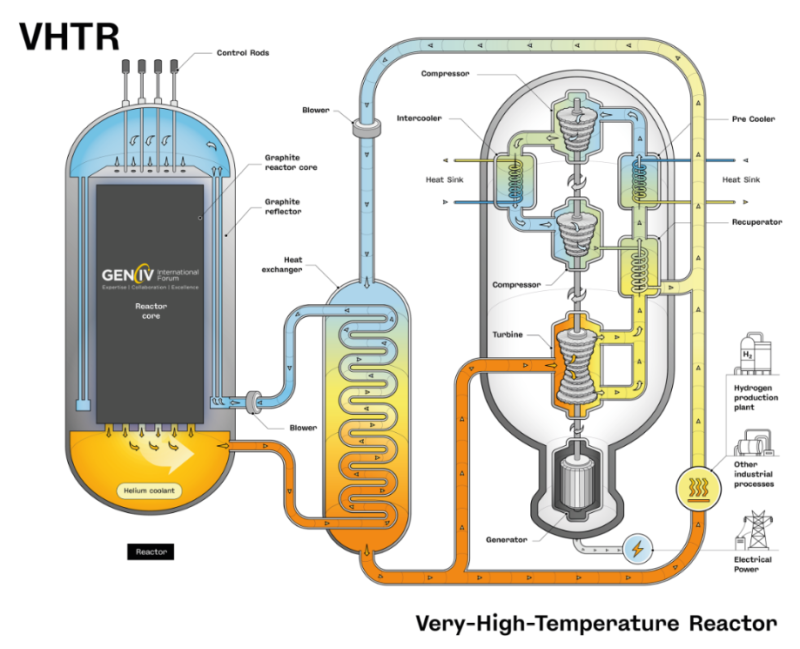
Figure 1. Schematic View of Gen. IV Very High Temperature Reactor Nuclear Energy System. SOURCE: [1]
Why Helium Brayton Conversion Fits High-Temperature Reactors
Very High Temperature Reactors (VHTRs) and Gas-cooled Fast Reactors are intended to deliver heat at temperatures substantially higher than conventional light-water reactors. The Generation IV International Forum describes VHTRs as graphite-moderated, helium-cooled systems capable of supplying heat and electricity over a core-outlet-temperature range of approximately 700 to 950°C, with higher temperatures considered as a longer-term objective. These conditions create an opportunity to use closed Brayton power conversion instead of relying exclusively on a steam Rankine bottoming system. [1], [3]
In a basic, non-recuperated helium Brayton cycle, helium is compressed, heated by the reactor or an intermediate heat exchanger, and expanded through a turbine to generate power. The gas is then cooled before returning to the compressor, completing the closed loop. A recuperated cycle builds on this arrangement by adding a heat exchanger that recovers thermal energy from the turbine exhaust to preheat the compressed helium before it reaches the reactor heat source. This reduces the amount of additional heat required and improves cycle efficiency. Recuperation is particularly valuable in closed helium cycles, where the pressure ratio for maximum efficiency may be relatively modest, leaving substantial recoverable energy in the turbine exhaust. [2], [3]
Beyond its role in cycle efficiency, helium offers several properties that make it well suited for high-temperature reactor applications. It is chemically inert, remains in a single phase throughout the operating range, and does not dissociate at reactor temperatures. These characteristics avoid the phase-change limitations associated with water and the chemical-reactivity concerns of some alternative coolants. Helium also has favorable neutronic properties, including low neutron absorption, which is particularly advantageous in fast-spectrum reactor concepts. [5], [7]
Yet, the same properties that make helium attractive as a reactor coolant can make it a difficult turbomachinery fluid. The central challenge is not merely building a gas turbine capable of surviving high temperatures, but rather designing a compressor-turbine-generator system whose aerodynamic, structural, thermal, rotor dynamic, sealing, and control characteristics remain compatible throughout normal operation and credible transients.
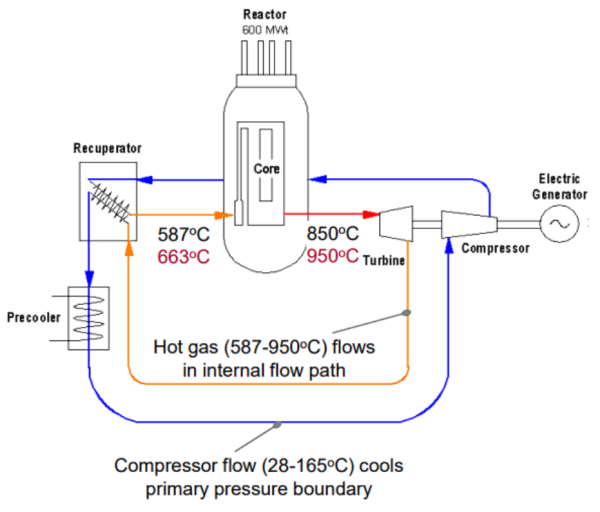
Figure 2. Basic Recuperated Closed Brayton Cycle.
Low Density Drives Aerodynamic Design
Helium has a much lower density than heavier gases at the same pressure and temperature. Delivering reactor-scale power can therefore require large volumetric flow rates, elevated system pressures, and potentially high blade speeds. Increasing circuit pressure raises helium density and helps keep turbomachinery dimensions manageable, but it also increases pressure-vessel requirements, seal loads, inventory-management demands, and stored energy.
These characteristics directly influence turbomachinery sizing. Compressors must accommodate large volumetric flows while delivering the required specific work without excessive diameter or stage count. Helium’s high speed of sound allows relatively moderate Mach numbers even at high blade speeds, while its high specific heat capacity can require greater peripheral velocities to achieve the necessary stage loading.
For large helium-cycle systems, these requirements generally favor multistage axial machines, which accommodate high flow rates and can share a common shaft with the turbine and generator. Radial configurations may be better suited to smaller modular systems with lower flow rates. [6], [7]
Preliminary design requires balancing flow coefficient, stage loading, hub-to-tip ratio, reaction, diffusion, solidity, tip clearance, and blade count. Improving design-point efficiency may compromise surge margin, while adding stages to reduce aerodynamic loading can increase shaft length, leakage paths, and rotor dynamic complexity.
High Rotational Speed Becomes a System-Level Constraint
High shaft speed is an enabling mechanism for compact helium equipment, but it cannot be selected from aerodynamic calculations alone. Centrifugal stress rises with the square of rotational velocity, while shaft flexibility, disk geometry, bearing stiffness, generator design, and critical-speed separation place independent limits on the rotor.
These competing aerodynamic and mechanical requirements are illustrated by General Atomics Electromagnetic Systems’ 44 MWe Fast Modular Reactor (FMR) conceptual design. The helium-cooled fast reactor uses a direct closed Brayton cycle with a high-speed turbine-compressor-generator operating at approximately 13,600 rpm. GA-EMS identifies active magnetic bearings, high-speed electrical generation, frequency conversion, and operation through several critical speeds as important enabling technologies. This example illustrates why the rotating assembly must be analyzed as one electromechanical train rather than as isolated turbine and compressor components. [7], [10]
When it comes to rotor dynamic analysis, engineers must consider lateral and torsional modes, bearing coefficients, unbalance response, thermal bow, gyroscopic effects, seal-induced forces, and possible cross-coupled aerodynamic stiffness. The rotor can pass through critical speeds during startup and coast-down, making transient bearing behavior and control-system stability as important as steady full-load operation.
Bearing choice adds another layer of consideration. Magnetic bearings can reduce lubricant-related contamination and permit operation at high surface speed, but they introduce requirements for sensor reliability, backup bearings, power electronics, touchdown management, and control-law validation. Conventional bearings may simplify some control aspects, yet lubrication and sealing become more difficult when the machine is expected to maintain a clean, high-pressure helium inventory.
Elevated Temperature Changes More Than Material Selection
The turbine operates at the highest temperature in the power-conversion loop. While these temperatures may be lower than those in advanced combustion turbines, helium turbine blades may operate without internal cooling. Nuclear applications also demand long operating periods, limited maintenance, minimal leakage, and high reliability, placing additional demands on component durability.
Thermal expansion can alter blade tip clearances, seal gaps, and bearing alignment, potentially causing rubbing during startup or excessive leakage at operating temperature. Designers must therefore account for how the rotor, casing, and other components heat up and expand under both steady-state and transient conditions.
Material selection must account for long-term creep, fatigue, and the oxidation, carburization, or decarburization that trace impurities in helium, such as H₂O, CO, and CH₄, can cause in high-temperature alloys. In direct-cycle systems, fission products and graphite dust carried from the reactor can also deposit on turbine surfaces, complicating inspection and maintenance.
Finally, uneven temperature distribution at the turbine inlet can create localized hot spots that affect blade life and rotor behavior. Managing these thermal gradients, along with the performance of high-temperature components such as ducts and heat exchangers, remains an important priority for Generation IV reactor development. [1], [5]
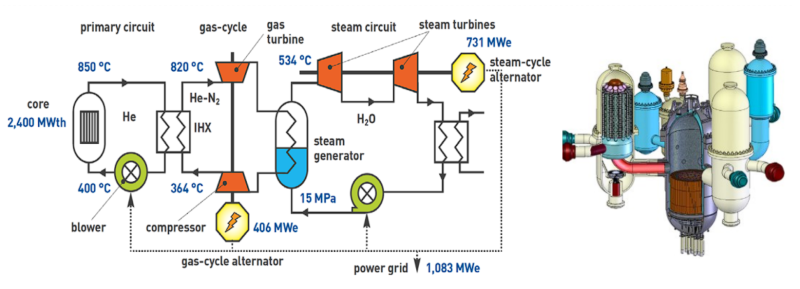
Figure 3. Example of a High-Temperature Helium Reactor and Power-Conversion System.
Leakage and Heat-Exchanger Performance Can Decide the Cycle
Helium’s small atomic size makes containment challenging, and leakage can affect more than the loss of working fluid. It can alter system pressure, compressor operating conditions, and ultimately net power output. Seal selection must therefore be considered early in the design process, accounting for both leakage and its effects on reliability and rotor dynamics.
Recuperator performance is equally important. Recovering more heat from the turbine exhaust improves cycle efficiency, but achieving higher effectiveness typically requires additional heat-transfer area, increasing pressure losses, size, and cost. These trade-offs are particularly important in helium cycles, where compressor power consumes a substantial portion of gross turbine output.
Additional cycle features, such as intercooling and reheating, can further improve efficiency by reducing compression work or increasing turbine output. However, these gains must be weighed against larger equipment, additional heat exchangers, and greater system complexity. As highlighted in Sandia’s assessment of high-temperature helium cycles, the most efficient thermodynamic arrangement is not necessarily the most practical or economical design.[3]
Why Integrated Simulation Is Essential
A sequential design process can overlook important interactions between cycle performance and turbomachinery design. For example, a cycle model may assume certain compressor and turbine efficiencies, only for detailed aerodynamic analysis to reveal different performance characteristics. Changes in pressure losses, shaft speed, or operating conditions can then affect the entire system, from compressor stability to thermal and mechanical loads.
An integrated approach addresses these interactions by connecting cycle-level modeling with turbomachinery design and analysis. Engineers can establish initial operating conditions, develop compressor and turbine flow paths, and feed their performance characteristics back into the system model. This iterative process helps evaluate both design-point efficiency and off-design behavior, including startup, shutdown, and load-following operation.
The AxSTREAM platform supports this workflow by connecting system-level simulation with preliminary turbomachinery design, performance analysis, and more detailed engineering evaluations. This allows engineers to assess how component design decisions influence overall cycle performance, identify operating limitations, and refine the system before moving into higher-fidelity analysis and physical testing.
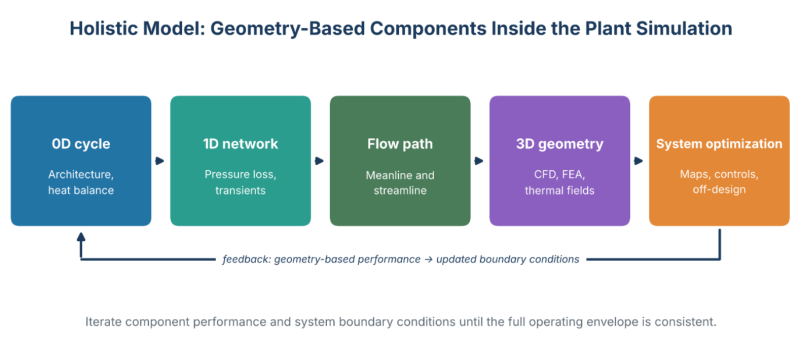
Figure 4. Integrated Simulation Workflow in the AxSTREAM Platform
A Holistic Modeling Approach in the AxSTREAM Platform
AxSTREAM System Simulation enables engineers to model helium Brayton cycles, including the reactor heat source or intermediate heat exchanger, recuperator, compressor, turbine, cooling systems, and controls. Its coupled 0D/1D thermal-fluid capabilities support steady-state and transient analysis, cycle architecture comparisons, and evaluation of system performance across operating conditions.
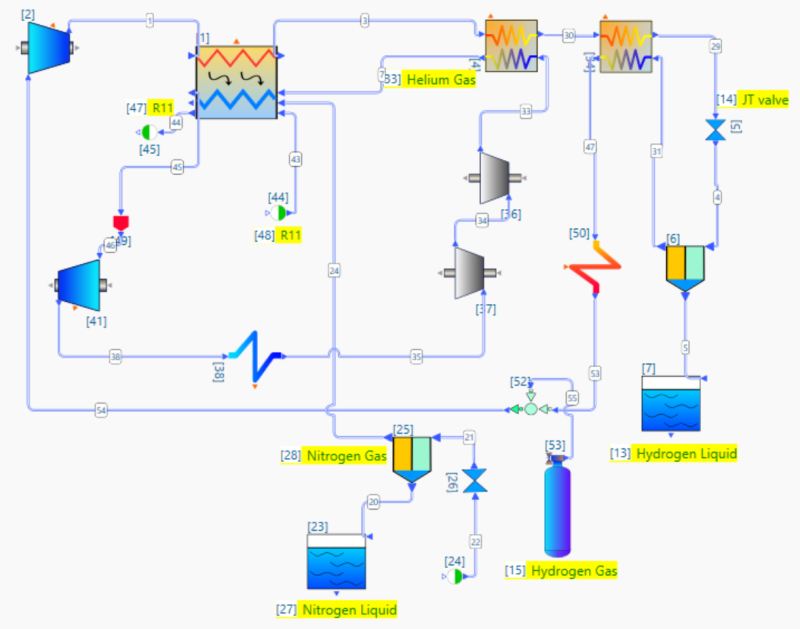
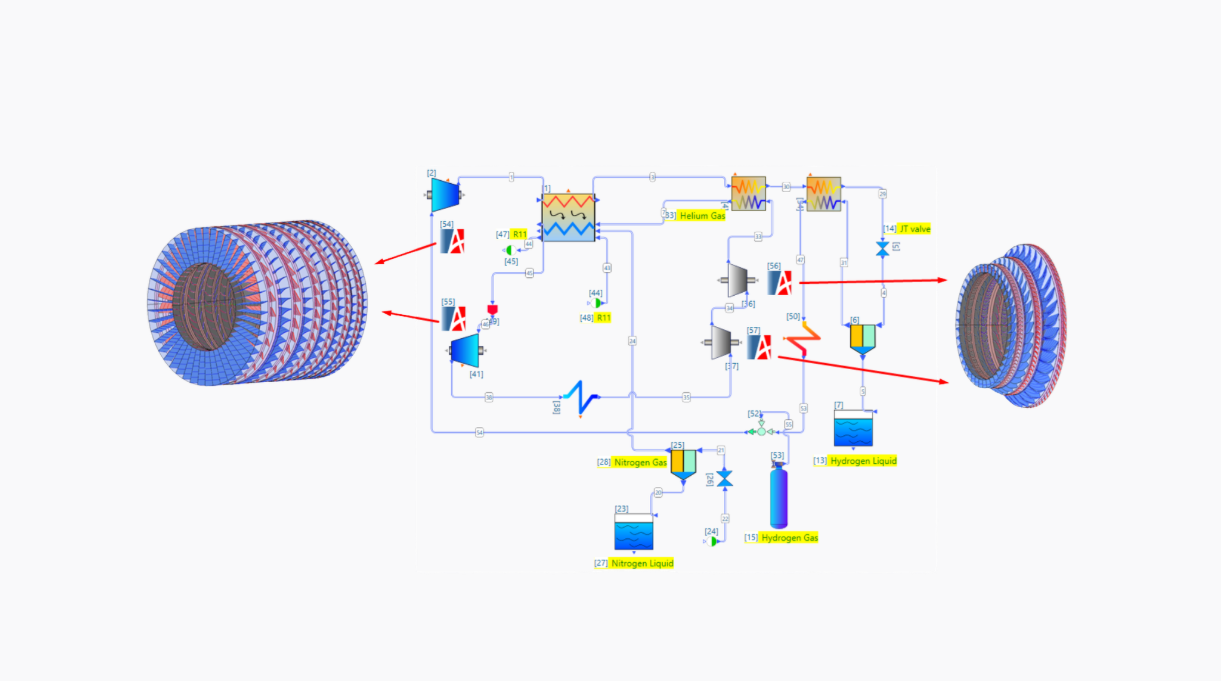
Figure 5. An Example of a Helium Brayton Cycle Modelled in AxSTREAM System Simulation
The broader AxSTREAM platform extends the workflow from the system level into turbomachinery design, analysis, and optimization. Compressor and turbine flow paths can be developed using preliminary design, 1D meanline and 2D streamline calculations, performance mapping, blade profiling, three-dimensional geometry generation, CFD, FEA, and optimization capabilities.
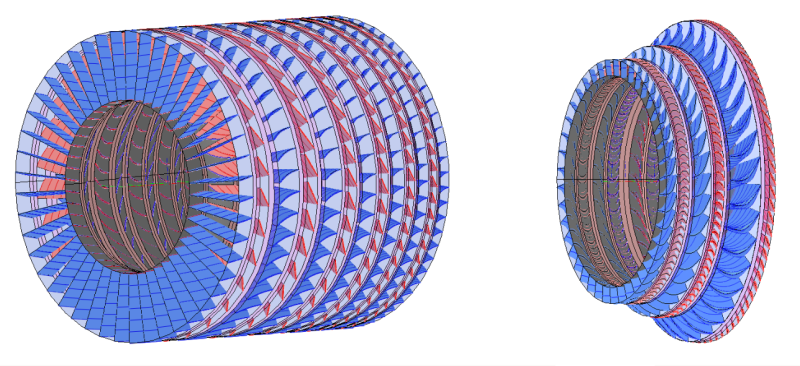
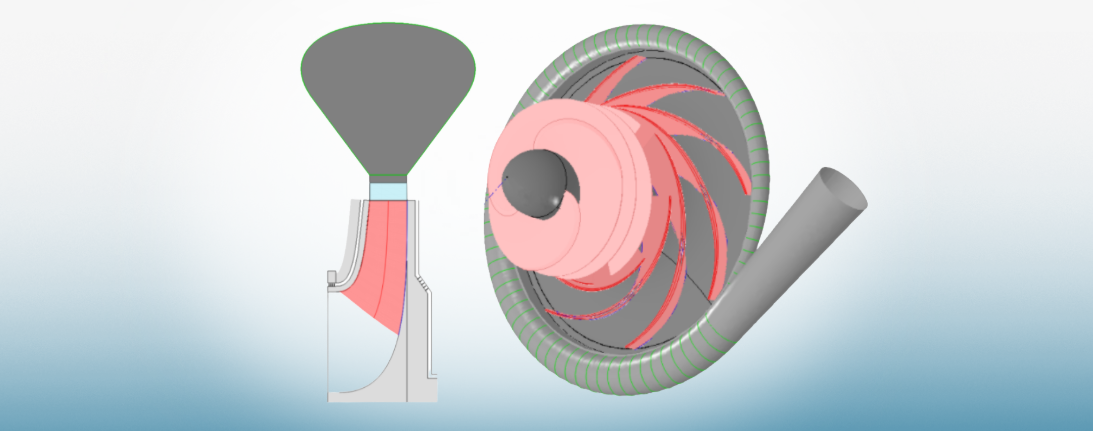
Figure 6. Axial Compressor (left) and Turbine (right) Designed in AxSTREAM Flow Path Module
A holistic model can connect the turbomachine component in AxSTREAM System Simulation with performance obtained from the AxSTREAM Flow Path environment. Instead of retaining generic efficiency assumptions, engineers can represent behavior derived from the actual flow path geometry and its calculated operating maps. System-level boundary conditions can then be returned to the detailed machine model, producing an iterative connection between 0D/1D cycle behavior and the compressor or turbine’s geometry-based prediction.
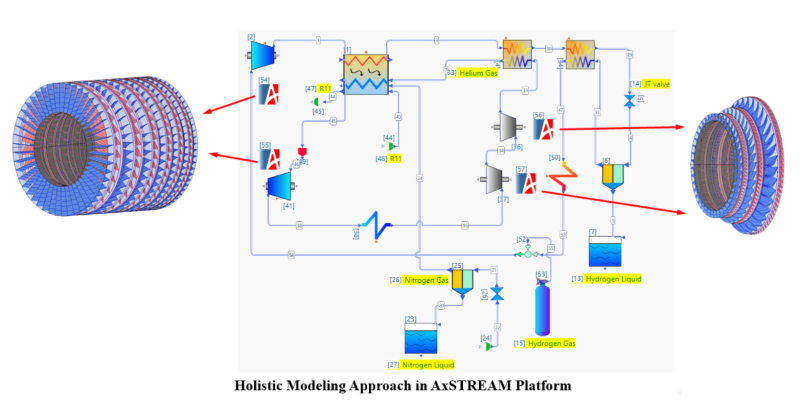
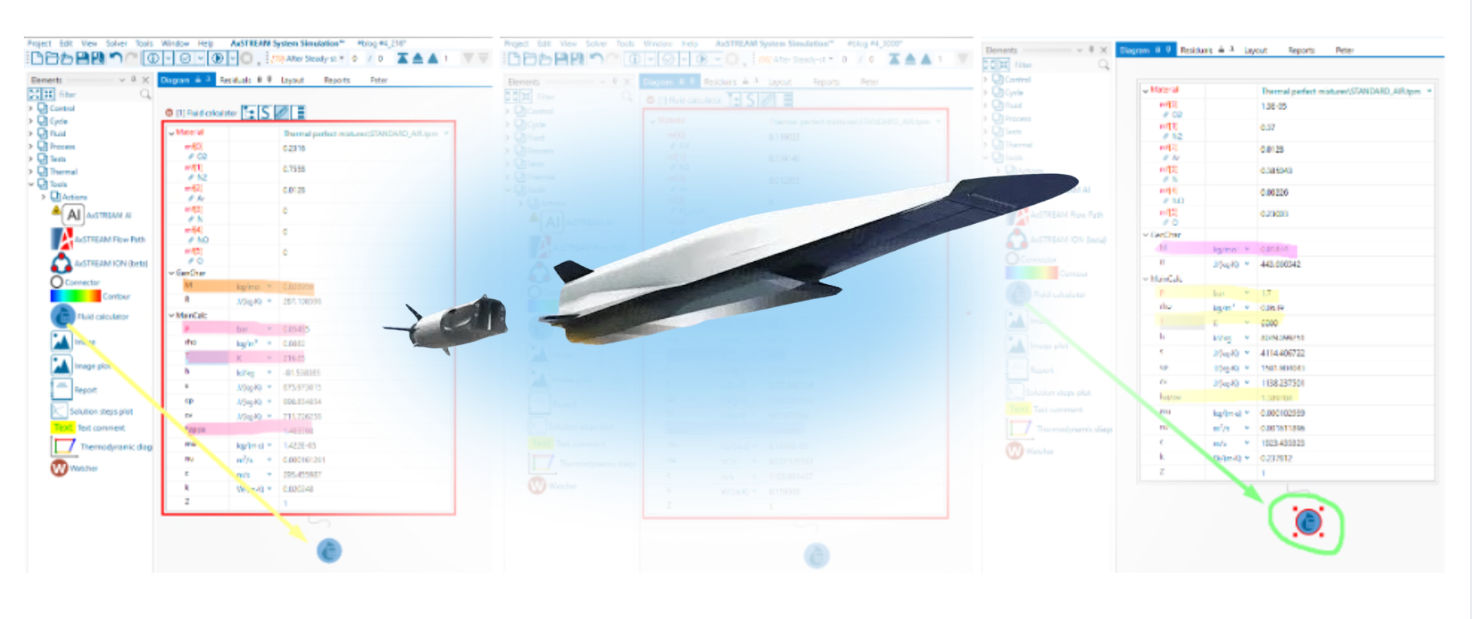
Figure 7. Holistic Modeling in the AxSTREAM Platform
This integration is particularly valuable for helium systems, where changes in pressure loss, leakage, rotational speed, or inlet temperature can shift the overall operating point. By connecting cycle simulation with detailed turbomachinery design, engineers can evaluate component interactions, compare configurations, and optimize the complete power-conversion system while identifying potential incompatibilities earlier in development.
The Path Forward for Helium Brayton Cycle Development
Helium Brayton cycles offer significant potential for efficient power conversion in high-temperature Generation IV reactors. However, realizing this potential requires addressing interconnected challenges involving fluid dynamics, thermal management, rotor dynamics, sealing, and transient operation.
Successful development therefore requires an integrated modeling approach that connects plant-level thermodynamics and system behavior with detailed turbomachinery design, heat transfer, structural analysis, and controls. Rather than evaluating these elements independently, engineers must consider how they interact across operating conditions.
The AxSTREAM platform supports this integrated workflow, combining helium Brayton cycle modeling in AxSTREAM System Simulation with turbomachinery design, performance analysis, multidisciplinary assessment, and optimization capabilities.
To learn more about how AxSTREAM can support helium Brayton cycle and turbomachinery development, contact our team or request a live demo.
References
- Generation IV International Forum, “Very High Temperature Reactor,” VHTR technology overview and system schematic.
- Skavdahl, I., et al., “Helium Brayton Cycle Design for Advanced High Temperature Reactor System,” Transactions of the American Nuclear Society, Vol. 115, 2016.
- Wright, S. A., Vernon, M. E., and Pickard, P. S., Concept Design for a High Temperature Helium Brayton Cycle with Interstage Heating and Cooling, Sandia National Laboratories, 2013.
- International Atomic Energy Agency, Design and Development of Gas Cooled Reactors with Closed Cycle Gas Turbines, IAEA-TECDOC-899, 1996.
- Hatala, B., and Kvizda, B., “Gas Cooled Fast Reactor,” 13th GIF-IAEA Interface Meeting, Vienna, March 2019.
- Lee, J., Lee, J. I., Ahn, Y., and Choi, M., “Preliminary Study of Helium Brayton Cycle Turbomachinery for Small Modular High Temperature Gas Cooled Reactor Application,” ICAPP, 2013.
- Choi, H., Bolin, J., and Back, C. A., “Progress of the Fast Modular Reactor Conceptual Design,” IAEA conference contribution.
- https://www.researchgate.net/publication/321278802_Innovative_power_generation_systems_using_supercritical_CO2_cycles
- High Temperature Gas Reactors The Next Generation? https://energy.mit.edu/wp-content/uploads/2017/02/2-3.-HTGR-Brayton-Cycle-YAN-MIT-talk-r1-min.pdf
- GT-MHR international project of high-temperature helium cooled reactor with direct gas-turbine power conversion cycle,
https://inis.iaea.org/records/44x8k-fgx38
"*" indicates required fields