Apr 27, 2026
Radial Forces in Centrifugal Machines and Why They Matter for Reliability
Radial forces are the load acting on a centrifugal machine’s impeller that are directed toward the axis of shaft rotation, and generally consist of a steady component with a superimposed pulsating component. When radial forces are present, they often result in additional stress on the shaft and bearings, leading to accelerated wear, the onset of vibrations, increased seal clearances, and a decrease in overall machine reliability.
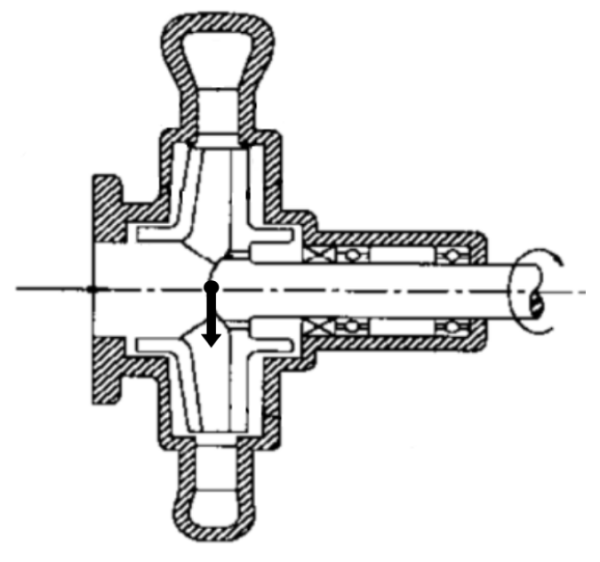
Figure 1. Radial Forces acting on the shaft’s center of rotation
Radial Force Methodology: Stepanoff, Gülich, and AxSTREAM Methods
In the early days of turbomachinery development, engineers noticed bearing wear and shaft deflection, but didn’t have a clear theoretical explanation of what was causing it. They later realized that these issues were linked to radial force, which forms from non-uniform flow.
Over the years, engineers have developed several different methods for estimating and calculating these radial loads in centrifugal machines to improve the equipment’s lifespan. One method that came about was the Stapanoff’s method, which takes into account the geometric parameters of the impeller and includes an empirical coefficient K, that depends on the operating mode [1]. However, this method is considered rather rough and not sufficiently accurate for today’s standards.
Then there’s the Gülich calculation model, which accounts for the type of volute and includes a flow-dependent coefficient k. One key advantage of this method is that it provides a much better understanding of how radial loads change under off-design operating conditions [2].
There are other models that use dimensionless coefficients, which can be useful for comparing pumps or compressors or for analyzing general relationships.
How to Calculate Radial Forces with AxSTREAM
AxSTREAM, SoftInWay’s software platform, determines radial force by integrating pressure along the circumference of the volutes. It can calculate for volutes of standard shapes, such as circular or trapezoidal, as well as irregular shapes. AxSTREAM also accounts for the interaction between the rotor and the diffuser or between the rotor and the volute [3].
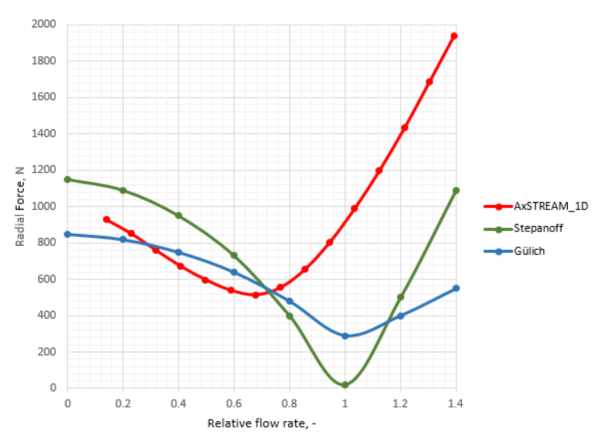
Figure 2. Radial forces determined by different methods
Figure 2 shows a comparison of the radial force results determined using the methods mentioned above; the calculations were performed for the single volute centrifugal pump model with impeller diameter D2 = 328 mm and shaft speed = 6000 rpm.
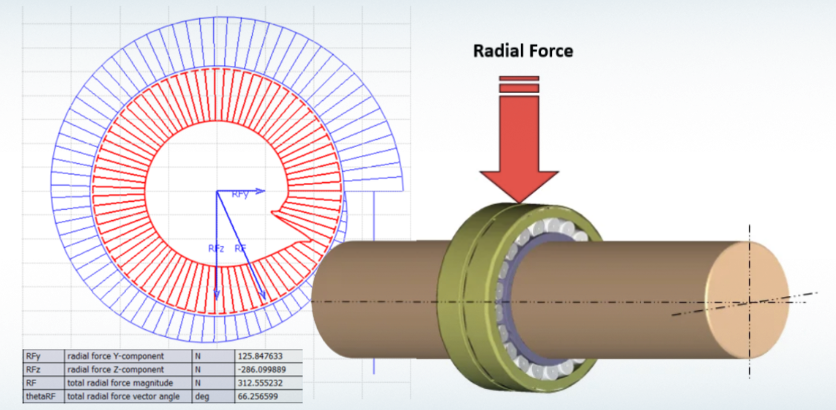
As a result of one-dimensional calculations in AxSTREAM, you can see the static pressure field at the inlet to the volute, the radial force vector, and its components (Fig. 3).
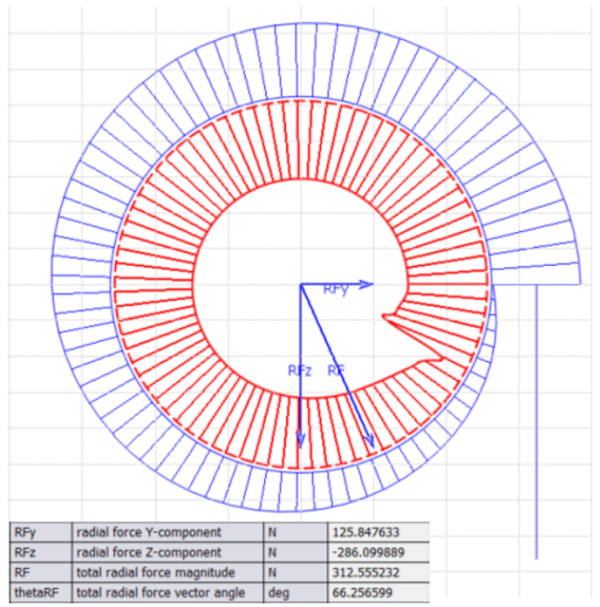
Figure 3. Static pressure distribution and Radial Force vectors in AxSTREAM
How to Minimize Radial Forces
Since radial loads are primarily caused by the non-uniform distribution of fluid velocities and pressures downstream of the impeller, the main method for balancing these forces involves making the flow as uniform as possible within the volute.
Engineers can achieve this in several ways. They can use special types of volutes, such as double-scroll volute or two exit volute. A vane diffuser can also help maintain uniform flow parameters circumferentially, since the diffuser is symmetrical. Optimizing the volute’s shape and the position of the tongue, etc., can further reduce radial forces.
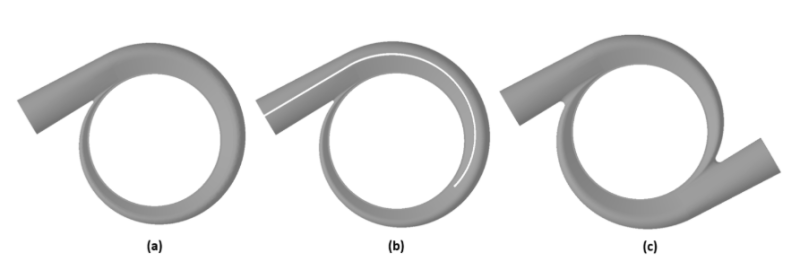
Figure 4. Different volute types: (a) – single volute, (b) – double-scroll volute, (c) – two exit volute
Additionally, selecting more wear-resistant materials for the shaft can minimize the negative impact of radial loads on pump operation and help extend the shaft’s service life.
The Effect of Radial Force on Bearings
Radial forces are one of the most common types of loads on bearings. Under a radial load, the bearing rings move relative to one another, generating internal friction. Stress begins to grow in certain areas of the bearing as the radial load increases.
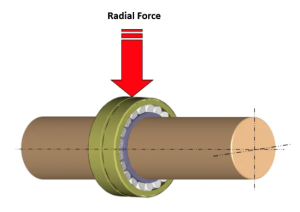
Figure 5. Radial Force acting on the bearing
Excessive loads lead to fatigue failure of the bearing rings and rolling elements, shortening their service life, and causing the bearing rings to deform, which can compromise shaft alignment. Increased loads create higher friction, which can cause overheating and may require higher-quality lubricants. For these reasons, when designing and working with bearings, it’s important to pay close attention to the magnitude and distribution of the radial load. Choosing the right bearings helps ensure reliable and uninterrupted operation of machinery and equipment.
The Importance of Balancing Radial Forces in Centrifugal Machines
Balancing radial forces is vital when designing centrifugal machines. Modern analysis methods enable engineers to accurately define a distribution of pressure and velocity along the flow path, as well as the magnitude and direction of the forces acting on the system, including radial loads on the impeller. These capabilities make it possible to identify potentially problematic areas as early as the design stage, perform parametric optimization, and attempt to minimize unfavorable force. Engineers can do this by optimizing the flow path geometry, selecting reasonable design configurations (e.g., the use of double-volute housings or diffusers) and ensuring stable machine operation during real-world operating conditions. SoftInWay’s software platform, AxSTREAM Flow Path, enables the evaluation of radial loads in the early stages of design, which can help engineers successfully mitigate the negative impact of these loads on the operation of centrifugal machines and bearings.
Test out AxSTREAM’s new model for calculating radial force with a software trial.
References:
A. Stepanoff, Centrifugal and Axial Flow Pumps: Theory, Design and Applications, New York: Wiley, 1957.
Gülich J.F. Centrifugal pumps, Second edition, Springer-Verlag, Berlin: Heidelberg, 2010.
SoftInWay Inc., “Radial Force on Centrifugal Impeller of Compressor and Pump in AxSTREAM”, 2026. [Online]. Available: https://wiki.softinway.com/v3.10.9/softinway-wiki/axstream-flow-path/axstream-positive-pressure-gradient-machine/axstream-ppg-documentation/radial-force-cc-impeller.md.
"*" indicates required fields