Nov 21, 2017
Gas Turbine Cooling – Enhance Current Advances with SoftInWay
Update – March 1, 2023: AxSTREAM NET is our legacy software depreciated by AxSTREAM System Simulation. System Simulation was born out of the union of the legacy AxCYCLE and AxSTREAM NET software packages.
The development of turbine cooling is a process that requires continuous improvements and upgrades. A gas turbine engine is a thermal device, and so it is composed of a range of major and minor cooling and heating systems. Turbine cooling is just a small part of the total engine system cooling challenges (combustor system cooling, heat exchangers, casings, bores, compressor and turbine disks, bearings and gears, etc.). However, effective turbine cooling is the greatest economic factor when it comes to engine development and repair costs, representing up to 30% of the total cost.
As a thermodynamic Brayton cycle, the performance of the gas turbine engine is influenced by the turbine inlet temperature, and the rise of this temperature can lead to better performance and more efficient machines. Current advancements in the development of cooling systems allow most modern gas turbines to operate at temperatures much higher than the material melting point. Of course, nothing would have been possible without the parallel development of advanced materials for structural components, as well as advances in computing resources and consequently in aerodynamic design, prognostic and health monitoring systems, and life-cycle processes. In particular, as far as the life of the machine is concerned, the high-pressure (HP) turbine contains the most advanced high-temperature alloys and associated processing methods, as well as the combustor, which represents the key components that have limited life and tend to strictly dictate the cycles of operation and the allowable time on the wing.
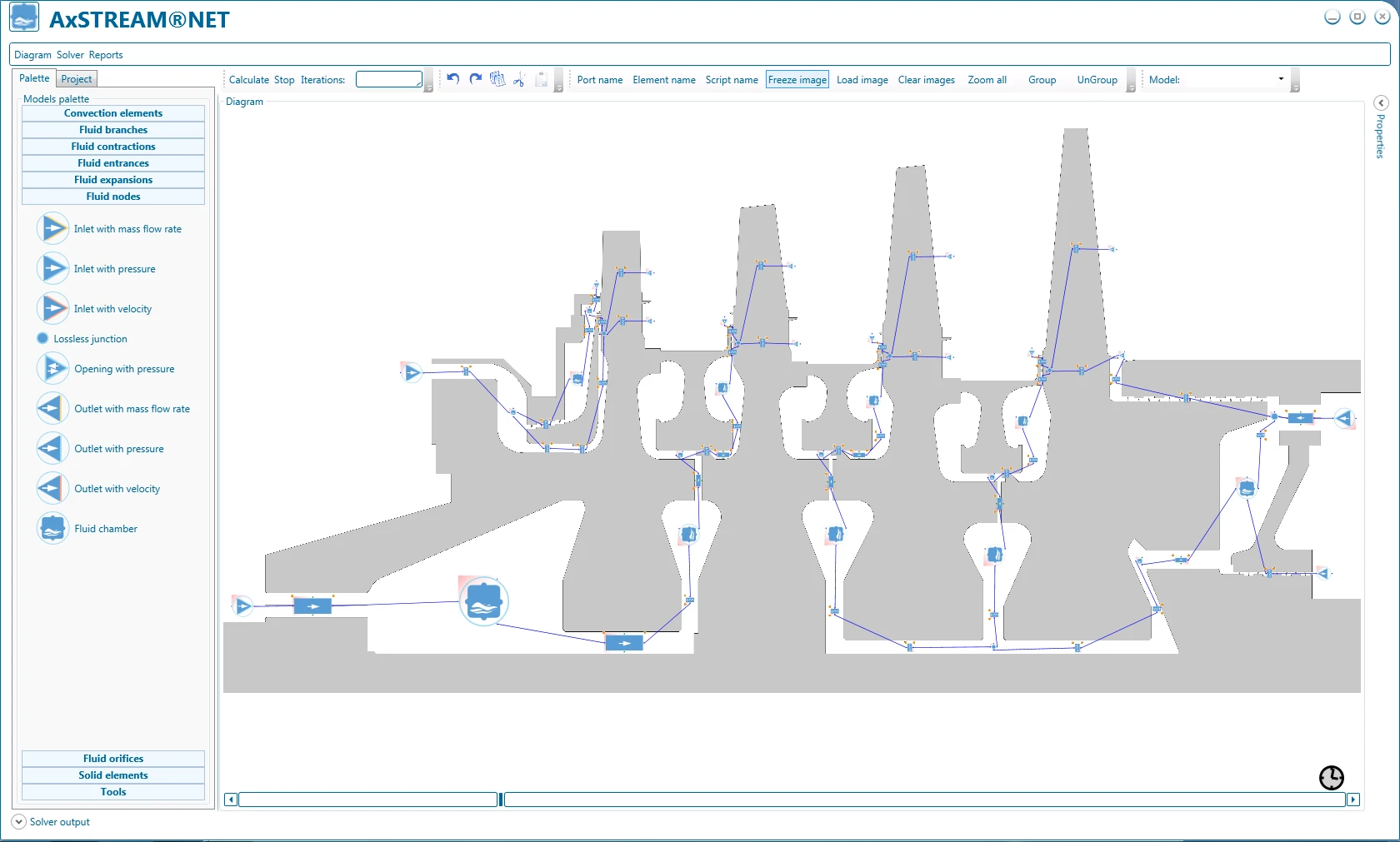
Figure 1. Turbine Cooling Scheme Designed in AxSTREAM NET
At SoftInWay, we follow the engineering needs, and we lead the turbomachinery software development market. For that reason, we accepted the challenge to model cooled gas turbines and other cooling flows, especially in an integrated fashion, taking into account the full aerodynamics of the components as well as the full thermodynamics of the cycle. AxSTREAM NET™ gives the user the possibility to design advanced and complex gas turbine cooling flow systems by representing thermal-fluid systems through networks of nodes and flow elements. The non-necessity for 3D geometry allows for its use before finalizing the blade geometry while keeping good accuracy in the results in a very short computation time. This helps considerably reduce the iteration time required to optimize aerodynamic cooling losses and machine performance. For more information, do not hesitate to ask our team and check out our most recent webinar to get a clear view of an automatic process to determine joint working conditions of turbine and compressor components with the entire secondary flow (cooling) system to improve the off-design performance of a gas turbine unit. View the recording here.
Reference:
Bunker RS. Evolution of Turbine Cooling. ASME. Turbo Expo: Power for Land, Sea, and Air, Volume 1: Aircraft Engine; Fans and Blowers; Marine; Honors and Awards ():V001T51A001. doi:10.1115/GT2017-63205.
"*" indicates required fields