Aug 14, 2026
Cryogenic Turboexpander Design for LNG Liquefaction: Flow Path Trade-Offs at Sub-Zero Operating Conditions
Cryogenic Turboexpanders face a complex design challenge when liquefying natural gas: they have to hold up under the same brutal cold they’re responsible for creating. That balancing act rests on the same fundamentals that matter for any turbomachinery, including aerodynamic performance, efficiency, and mechanical reliability. The low operating temperature leads to a decreased volume flow rate, which can cause low efficiency, low power generation, and can even cause ice to form at the outlet of the turboexpander. This, of course, can be mitigated, but one must know what to look for and how to improve the machine’s performance to avoid designing a sub optimal turboexpander.
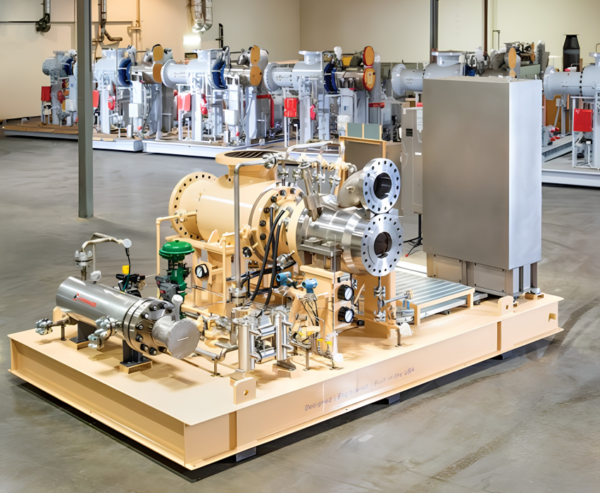
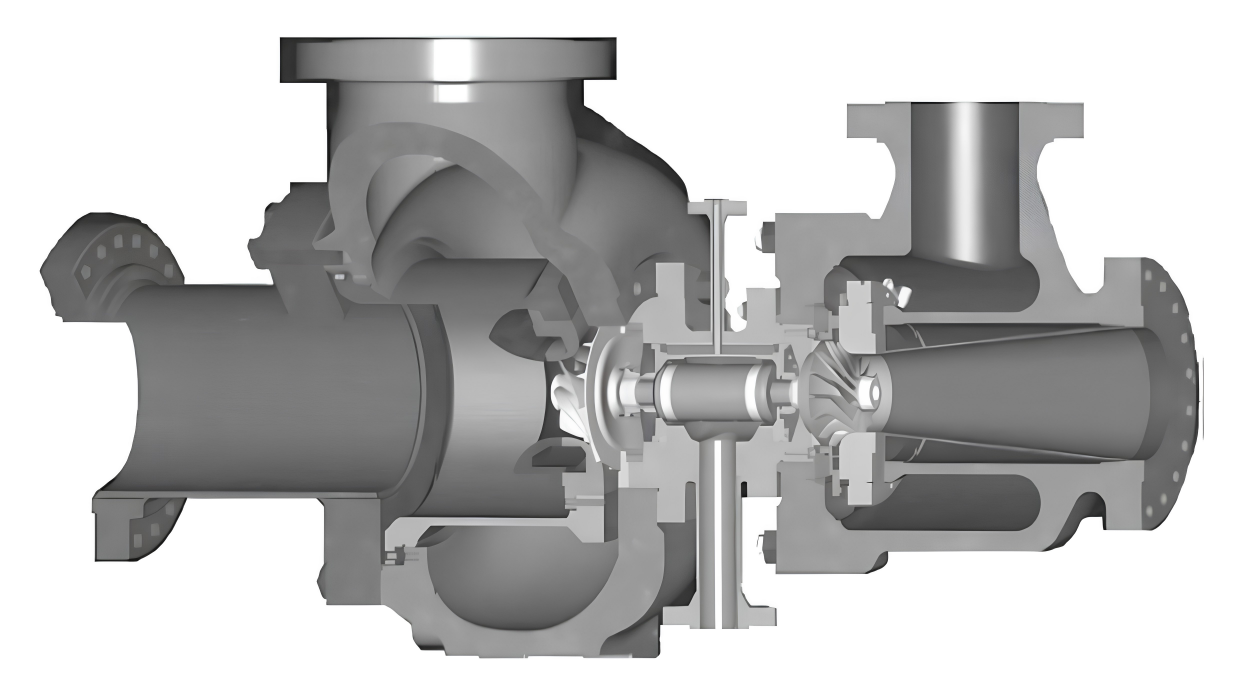
Figure 1. Active magnetic bearing turboexpander-compressor with on-skid controller
Aerodynamic Performance and Blade Profiling for Cryogenic Turboexpanders
The aerodynamic performance of a turboexpander is heavily influenced by the operating conditions and working fluid, which can lead to intense swirling of the flow and cavitation as that fluid moves through the impeller. This swirling can lead to flow separation around the blades, which in turn causes a decreased efficiency.
Performing careful blade profiling—altering geometric properties of the airfoil, such as stagger and gauging angles, leading edge and trailing edge radii, and chord length—can improve the machine’s aerodynamic performance. As changes are made to the blade profiles, one can monitor aerodynamic criteria that help us predict whether flow separation will occur or not. By improving this criteria, the flow separation caused by swirling can be mitigated and can avert aerodynamic performance related issues.
Low Operating Temperatures and Lower Volumetric Flow Rate
The low operating temperature leads to a higher fluid density, and therefore lower volumetric flow rate (VFR). A smaller VFR typically means a smaller machine, and in smaller machines, losses have a more intense impact on the machine’s performance than in a larger one. Finding a turbine geometry that can accommodate both the low temperature and the VFR requirements is an important step in the design process. Doing so ensures the efficiency of the machine remains reasonable.
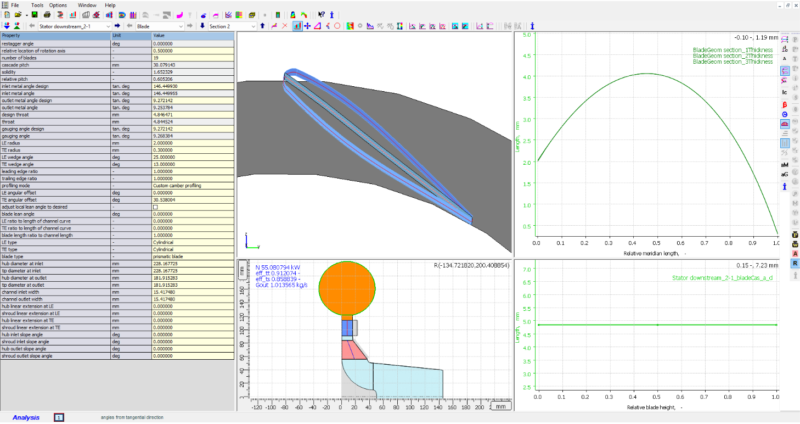
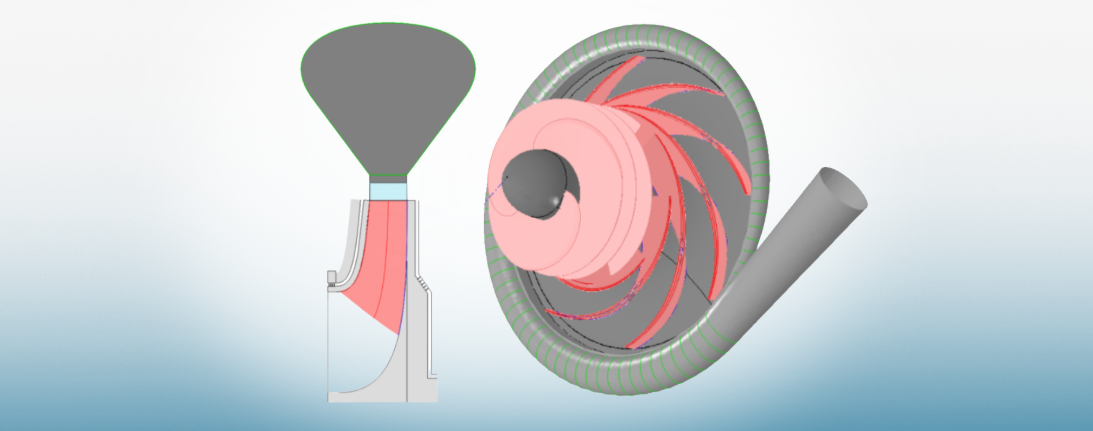
Figure 2: Radial Blade Design module in AxSTREAM FlowPath
The Efficiency Challenge of Cryogenic Turboexpander Design
The overall efficiency of the turboexpander is impacted by more than just flow separation. The expansion ratio, temperature drop, tip leakage, geometry of the inlet guide vanes, and countless other properties all impact the efficiency of the machine.
However, in a cryogenic turboexpander, where the pressure ratio and therefore the available heat drop can be small, having high efficiency is especially critical, as it means that more shaft work can be extracted from the fluid which is necessary for liquefaction.
The tip leakage, profile losses, among other losses will contribute to a decrease in efficiency, so ensuring that clearances and blade profiles are not leading to excess loss is necessary. Engineers can perform experiments via simulation on a design to catch these potential issues early. Optimizing to find the best possible values for these properties will aid in preventing unnecessary efficiency loss.
Bearings, Cavitation, and Mechanical Reliability
The mechanical reliability of a turboexpander refers to the probability that the machine will operate without failure. This is a crucial metric to understand for any machine to determine life expectancy and future repair needs, as well as to prevent failure and subsequent disaster. Though the working fluid of cryogenic turboexpanders can be natural gas, nitrogen and/or methane, cryogenic liquid turboexpanders are used as well, and the low vapor pressure of the liquid contributes to cavitation around the blades. This causes damage that builds over time and leads to failure. Preventing cavitation through blade profiling is necessary to ensure a long-life span for the turboexpander.
The bearings of the machine can also experience failure. Cryogenic turboexpanders require specific types of bearings to accommodate the operating conditions, and using an inappropriate type will cause failure. For example, the lubrication system of the bearings must be pressurized, as the placement of the bearings often leads to them being exposed to high pressure gas. This pressurization also prevents working fluid leaks. Making the right selection for these components is a necessary step in the design process. Utilizing analysis tools like rotor dynamics to evaluate the bearing selection and location along the shaft will ensure that mechanical reliability will not be a concern in the operation of the cryogenic turboexpander.
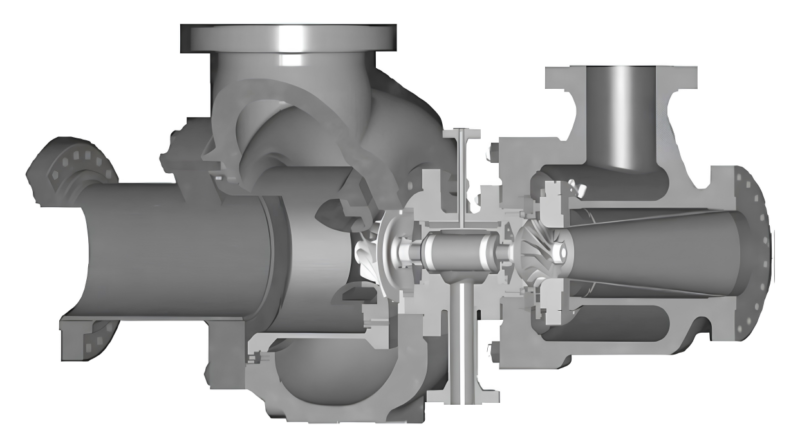
Figure 3: Typical turboexpander
Tradeoffs to Consider in Cryogenic Turboexpander Design
As engineers work to improve the design and performance of their turboexpander, they inevitably run into tradeoffs. For instance, when maximizing liquefied natural gas (LNG) recovery, the power requirements will also be maximized. A higher expansion ratio, and therefore lower temperature, will increase LNG recovery. However, a higher pressure ratio also means that more power is required by the compressor to recompress the residual gas. Using an optimization algorithm for these two parameters will determine the best balance between them.
Another example is the extremely low outlet temperature which has the potential to allow ice to form at the outlet of the turboexpander, breaking the machine. During operation, monitoring the moisture levels can help prevent failure, but even before that, one can design the turboexpander to have the desired outlet temperature. There are many tradeoffs associated with any sort of turbomachinery design, but the cryogenic operating conditions of liquefied natural gas turboexpanders lead to more unique potential issues.
Simulation and Analysis Before Manufacturing
Prior to manufacturing, extensive simulation and analysis in a cryogenic turboexpander is necessary to save resources and prevent disaster. Monitoring the aerodynamic performance, efficiency, and mechanical reliability of the machine during this stage will prevent issues in the geometry from making it all the way to manufacturing. Utilizing turbomachinery design and analysis tools, like the AxSTREAM software suite, is extremely useful when designing a turboexpander.
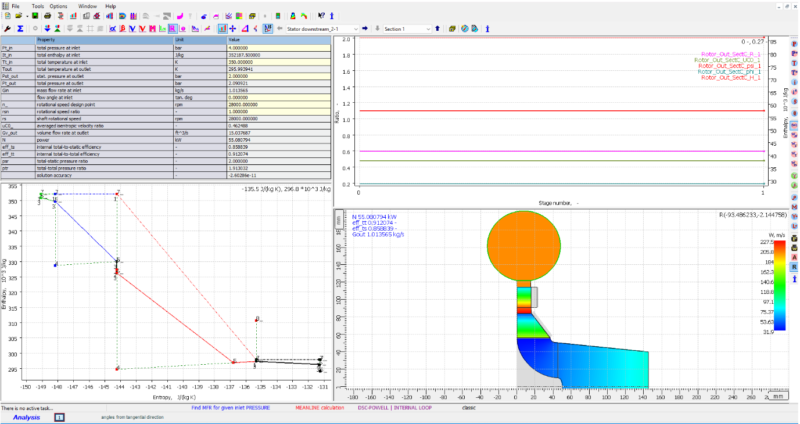
Figure 4: 1D/2D Streamline Calculation module in AxSTREAM FlowPath
With AxSTREAM FlowPath, engineers can design turbomachinery completely from scratch, starting with preliminary design, all the way to detailed design, finite element analysis, and CFD in one integrated environment. Engineers can easily make changes and iterate their design, leaving them with more time to focus on design decisions rather than overseeing manual handoffs from module to module. The loss models available for use in calculations provide realistic results, which are especially useful for a machine like a cryogenic turboexpander that has so many challenges and places for potential failure. Using AxSTREAM enables engineers to make thoughtful and educated decisions on the design, allowing them to modify the geometry with the assistance of optimization algorithms and catch issues early in the design process. AxSTREAM not only helps to improve the turboexpander’s efficiency, but the engineer’s efficiency, too. Designing a functional cryogenic turboexpander doesn’t have to be a daunting task. Though there are challenges with this specific type of machine, being mindful in the design process will lead to a more reliable, efficient, and high-performance cryogenic turboexpander.
References
- Sun, Shan, Cavitation Suppression and Design Optimization in a Cryogenic Liquid Turbine Expander Based on Thermodynamic Cavitation and Entropy Production Analysis, ASME Digital Collection, 2023.
- Unknown, Digital Exclusive: Turbomachinery: The backbone of cryogenic gas processing, Gas Processing & LNG, 2025.
- Midstream Calculator, Turboexpander Efficiency Fundamentals, Engineering Guide, 2025.
- T. Avetian, L.A Turbine, Fundamentals of turboexpander design and operation, Gas Processing & LNG, 2020.
- Jumonville, Jigger, TUTORIAL ON CRYOGENIC TURBOEXPANDERS, Mafi-Trench Corporation, 2004.
- Verma, Rahul, CF analysis of turboexpander for cryogenic refrigeration and liquefaction cycles, Cryogenic Engineering Centre, Indian Institute of Technology Kharagpur, 2014.
- Unknown, Turboexpanders Explained: How Expansion Turbines Make Cold & Recover Power, Bluestream Academy, 2026
- TMI Staff & Contributors, Turboexpander Optimization, Turbomachinery Magazine, 2015.
"*" indicates required fields