Apr 2, 2026
Axial Turbine Design: Small Assumptions with Big Mechanical Consequences

The design of an axial turbine—or any turbomachinery component—requires careful attention to detail. In the preliminary design phase, engineers typically focus on the primary limiting factors: boundary conditions, geometric constraints, power output, and other system-level requirements. As the design matures, however, attention naturally shifts toward the smaller parameters that can still have a significant impact on performance.
Properties like the number of blades, stagger angle, and loading assumptions may seem minor, but they all play a big role in the turbine’s mechanical stress and efficiency. In this blog, we’ll explore how adjustments to these seemingly small geometric parameters can drastically influence overall performance —and how engineers can use tools like AxSTREAM to help make those adjustments effectively. Even though they aren’t necessarily the primary focus early in the design process, overlooking them can lead to costly inefficiencies later on.
Optimal Blade Count and Blade Hub Stress for Axial Turbine Design
When running the preliminary design module in AxSTREAM, the software determines the optimal number of blades for the stators and rotors. However, when engineers make adjustments to the design—like changing the blade profiles or boundary conditions—the initial optimal blade count may change.
The blade count heavily influences aspects of the turbine’s performance, sometimes even more than blade height [1], so it’s important to pay close attention to the resulting parameters when analyzing a turbine with a different number of blades.
Another consideration is the stress at the blade hub, where the blade connects to the disk. These hubs experience higher stress concentration, making them potential locations where the blade is more likely to bend or crack during operation. Increasing the number of blades on the disk creates more points of high stress concentration, and in turn increases the number of locations for a potential failure. A higher number of blades can also reduce overall turbine efficiency through a decrease in net tangential flow velocity and increase in axial flow velocity.
However, blade count also influences the relative flow, and some turbine designs may require a higher blade count to achieve a desired flow direction [1]. So, all of these factors must be considered when finding the optimal blade number for a turbine.
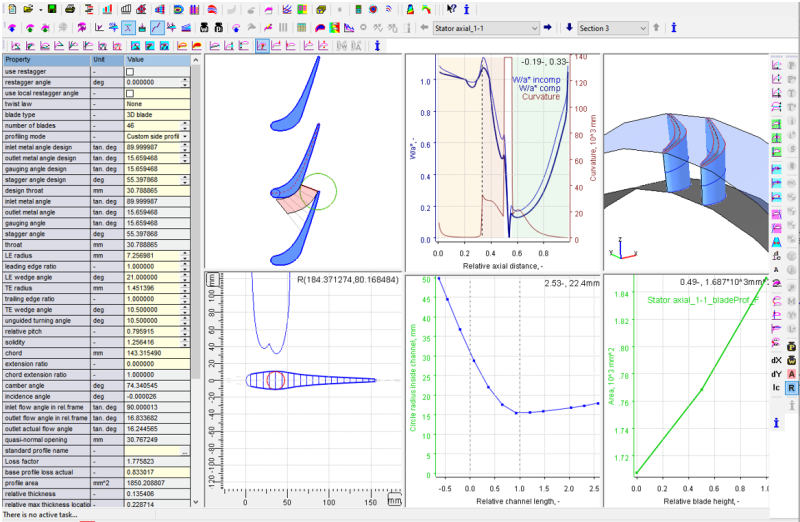
Figure 1. Blade profiling window in AxSTREAM
Changing the number of blades without adjusting the size of the hub also means the blade profiles need to be reevaluated. Adding or removing blades will alter the space between blades, or the throat, which will impact other properties, like relative velocity. Reprofiling the blades in this instance can help ensure that the values of these properties are appropriate and don’t worsen the turbine’s performance.
Stagger Angle Adjustments for Axial Turbine Design
The stagger angle of a turbine blade is the angle between the chord line and a vertical reference line at the tip of the blade. This angle can impact the shape of the blade profile and the throat area. Similar to blade count, changes to the throat area or shape will impact the aerodynamic properties of the blade profile. This will require engineers to reevaluate the blade profile to accommodate the new aerodynamic parameters.
Adjusting the stagger angle—as well as the inlet and outlet angles—can also impact flow distribution through that stage of the turbine. Optimizing the stagger angle can enhance flow stability and create a more uniform flow distribution. The inlet and outlet angles can also contribute to this by controlling entropy generation [2].
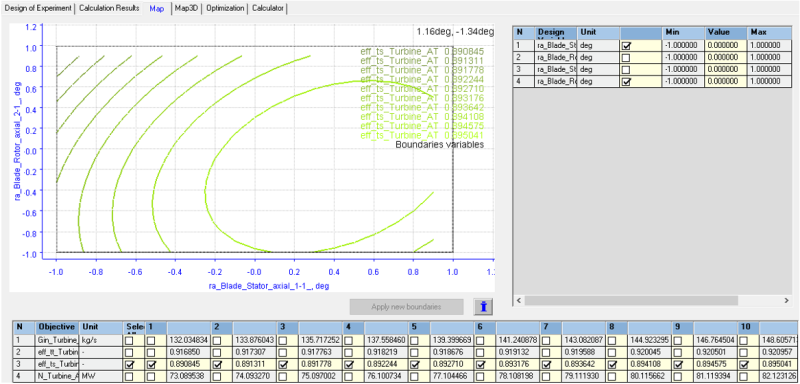
Figure 2. 3D response surface for efficiency with variable restagger angles
Loading Assumptions for Axial Turbine Design
Making assumptions about turbine behavior is necessary to create a digital model. We can’t know exactly how it will perform until a prototype is made and tested, so all calculations done prior to that are done under some assumptions. AxSTREAM offers many loss models and calculation types to estimate performance, making the software’s results extremely realistic. In AxSTREAM, engineers can also select the type of aerodynamic loads they use for their calculations. Selecting an inappropriate approach, like neglecting pressure loads, can lead to behavior discrepancies between the model and real life. Though this can be helpful to get a preliminary idea of how the blade will behave, it isn’t sufficient for a detailed analysis.
Similarly, when it comes to mechanical stress, assumptions like the blade material or making a simplified hub design to use for initial calculations, can also have a major impact on the results. The AxSTREAM software platform is validated against real-world data, so when properly configured, finite element analysis results are realistic.
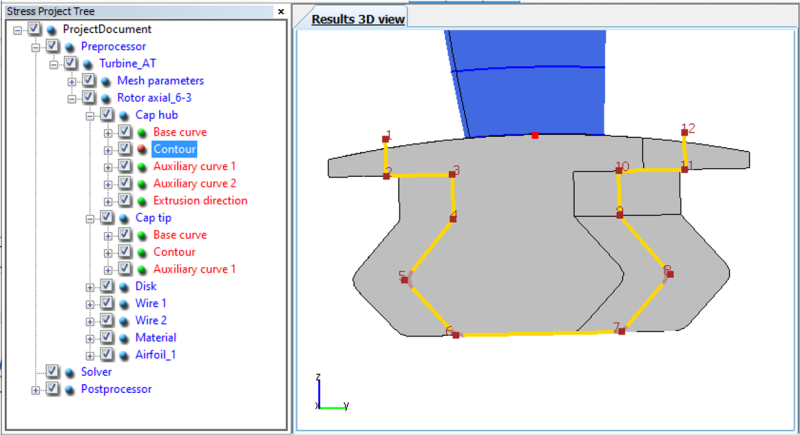
Figure 3. Example of an axial cap hub
The Impact of Small Parameters in Axial Turbine Design
It’s critical to consider these small geometric properties early in the design process because of how big of an influence they can have on overall turbine performance. Waiting until the detailed design phase to finalize parameters, like blade count, can lead to late-stage redesigns that could have been avoided from the start. With AxSTREAM’s full integrated engineering environment, teams can determine optimal values for these parameters to ensure top turbine performance. Even if these adjustments are needed later on in the project, making thoughtful and reasonable selections early provides a realistic estimate of how the final geometry will perform. As with many things in engineering—and in life—it’s often the little things that matter the most.
References
- P. Singh, “Experimental investigation of the influence of blade height and blade number on the performance of low head axial flow turbines,” Academia, 2011.
- S.E. Hosseini, “[2401.02102] Numerical Simulation and Aerodynamic Optimization of Two-Stage Axial High-Pressure Turbine Blades,” arXiv, 2024.
"*" indicates required fields