Sep 28, 2026
Turbochargers in Hybrid Vehicles: Are They Still Relevant?
As automotive electrification accelerates, it is reasonable to ask whether turbochargers still have a meaningful place in vehicle development. A battery-electric vehicle does not require an exhaust-driven compressor, yet transportation is transitioning through several architectures rather than one. Mild hybrids, full hybrids, plug-in hybrids, range extenders, commercial vehicles, and off-highway machines continue to use combustion engines where efficiency, power density, packaging, cost, and refueling time remain important engineering constraints.
Within these architectures, the turbocharger is not simply surviving as a legacy component. Its function is evolving. Conventional turbocharging can support engine downsizing and higher specific power, while electrified boosting can add faster response, exhaust-energy recovery, and greater control over intake and exhaust conditions. So, the turbocharger is becoming more closely integrated with the vehicle electrical system, combustion process, aftertreatment system, and supervisory controls. [1, 7, 10]
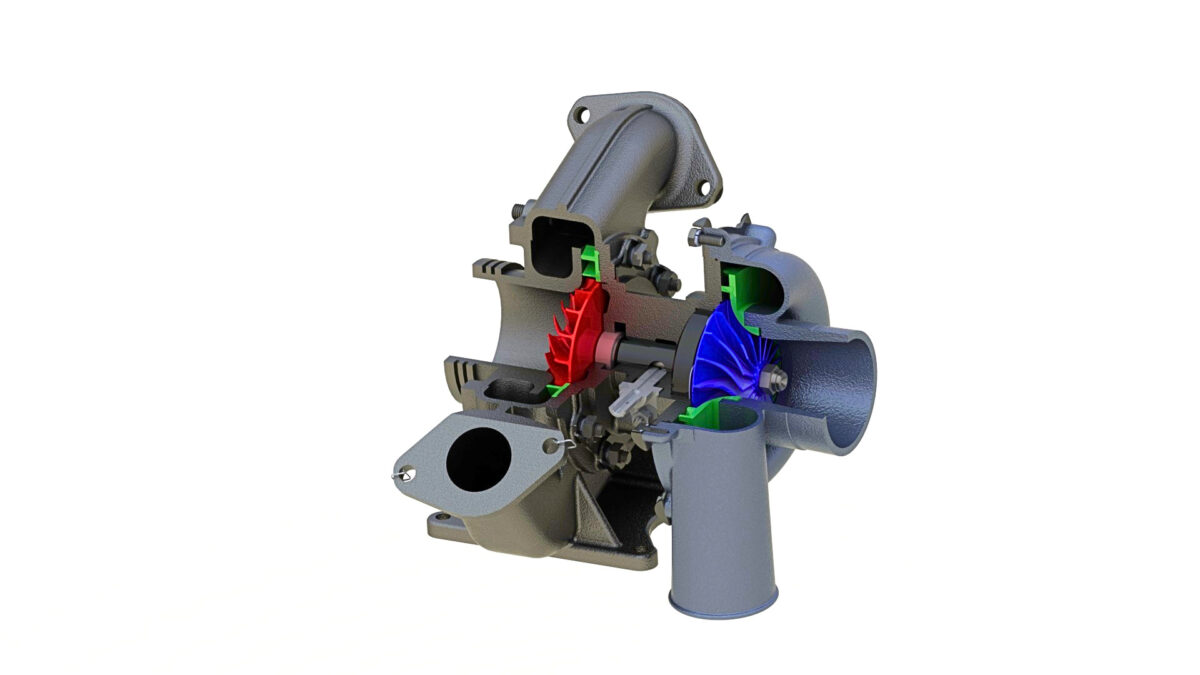
Figure 1: Turbocharger
The practical answer is yes, turbochargers are still relevant in hybrid vehicles, but with an important qualification: turbocharging is relevant only when it creates measurable system-level value. That value may arise from sustained power capability, a smaller engine, reduced battery torque-filling demand, energy recovery, improved combustion control, or aftertreatment support. This blog walks through how hybridization changes the engine’s operating requirement, where turbocharging delivers the most value across hybrid architectures, and how modern tools like AxSTREAM can supports designing the turbocharger system in these vehicles. The first step is to understand how hybridization changes the engine’s operating requirement.
How does Hybridization Change the Engine’s Operating Requirement?
A hybrid motor handles launch, regenerative braking, low-load driving, and short torque demands, reducing how often the engine needs to run. But it doesn’t eliminate the need for sustained power during highway cruising, towing, gradients, high payloads, or driving after the battery is depleted.
That gives the motor and downsized turbocharged engine complementary roles. The motor provides immediate torque and recovers and delivers energy when needed, while the engine provides compact, repeatable power for longer-duration demands. Together, they can reduce the need for both a larger engine and a battery large enough to handle every sustained peak. [1, 2]
With that in mind, the useful question isn’t simply, “Does this engine need boost?” It’s: Does the boosting system improve energy use, emissions, mass, cost, or performance across the real drive cycle?
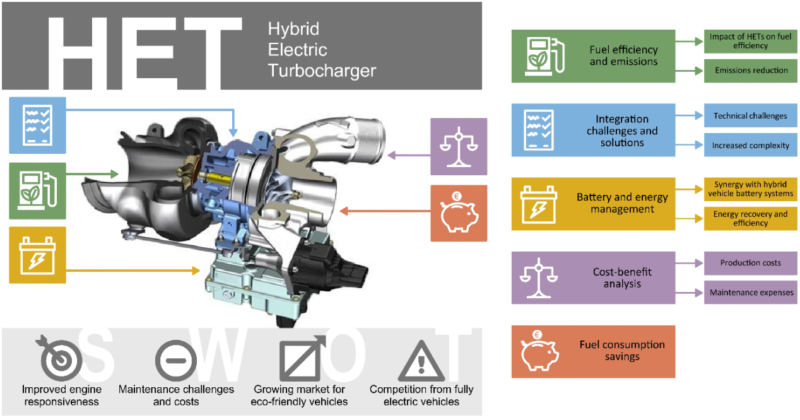
Figure 2. Hybrid Electric Turbocharger and its Principal System Benefits. SOURCE: [1]
Motor Torque and Boost Response Are Complementary
Electric torque can hide turbo lag, but the battery is still doing the work as it still supplies the missing power while engine airflow builds. Filling that gap repeatedly brings conversion losses, battery cycling, and extra cooling. Faster boost eases burden and frees up electrical power for launch, recuperation, and operating-point control.
An e-turbo places a high-speed motor-generator on the turbo shaft. It accelerates the compressor when exhaust energy is low and can generate electricity when turbine power exceeds compressor demand. Since low-speed response is no longer tied entirely to exhaust flow, engineers can select the turbine for lower backpressure, better high-flow efficiency, or recovery potential. [7, 9, 10]
The improvement, though, is application-specific. BorgWarner reported over 200% better transient boost response and a 50% reduction in time-to-torque in one high-voltage hybrid program. The actual benefit in any given vehicle still depends on calibration, electrical losses, battery limits, and how often those transients occur. [11]
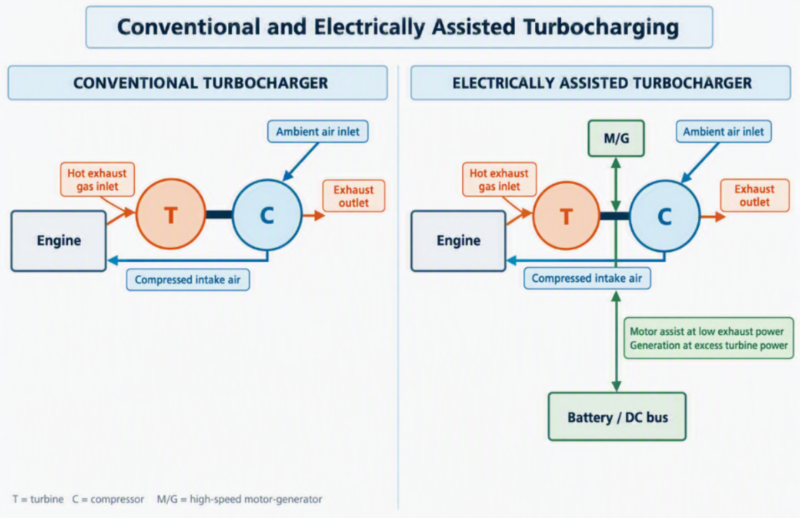
Figure 3. Conventional Exhaust-Driven and Electrically Assisted Turbocharger Architectures. SOURCE: [1]
Exhaust-Energy Recovery: Useful, but Duty-Cycle Dependent
A wastegate normally bypasses excess exhaust energy after the target boost is reached. An e-turbo can instead apply generator load and turn part of that surplus into electricity for traction, the battery, or auxiliaries. But the real gain must include turbine backpressure, generator and inverter losses, battery acceptance, and thermal limits.
A 2025 SAE simulation of a production-based 2.0-litre gasoline engine found up to 21 kW of recoverable power at modeled high-load points, with net recovery near 9 to 11% of crankshaft power at selected conditions. This was not a whole-cycle fuel-economy result. Urban hybrids with frequent engine-off operation may offer little opportunity; highway, performance, and heavy-duty hybrids can offer much more. [3]
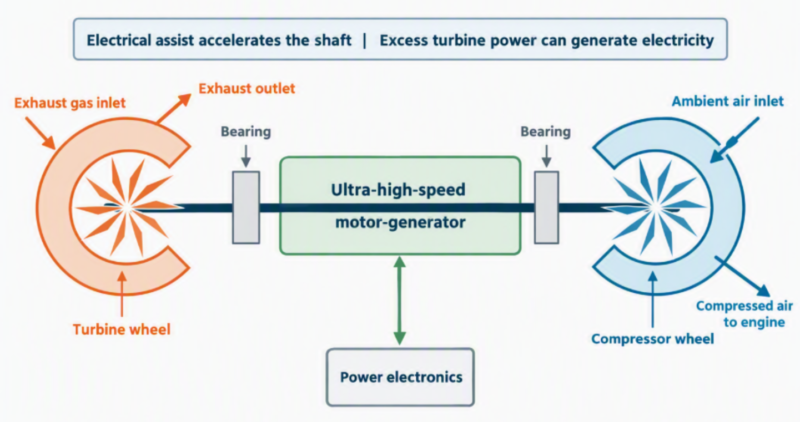
Figure 4. Electrically Assisted Turbocharger Hardware Integrating Turbine, Compressor, Motor-Generator, Bearings, and Power Electronics. SOURCE: [10]
Efficiency and Emissions Must Be Evaluated Together
Turbocharging can lower CO₂ when it enables downsizing, downspeeding, Miller-cycle operation, EGR, or more efficient high-load combustion. But hybrid engines also stop, restart, and change load quickly, and a sudden high-power start with a cold catalyst can create a disproportionately large emissions event. [4, 5, 8]
That’s why boost hardware must be developed with the engine and aftertreatment system, not separately. Compressor response, turbine backpressure, EGR, air-fuel ratio, catalyst temperature, start strategy, and supervisory control all interact. An e-turbo adds air-path authority, but cleaner operation must be proven in coupled simulations and tests, not assumed from component efficiency. [4, 6, 11]
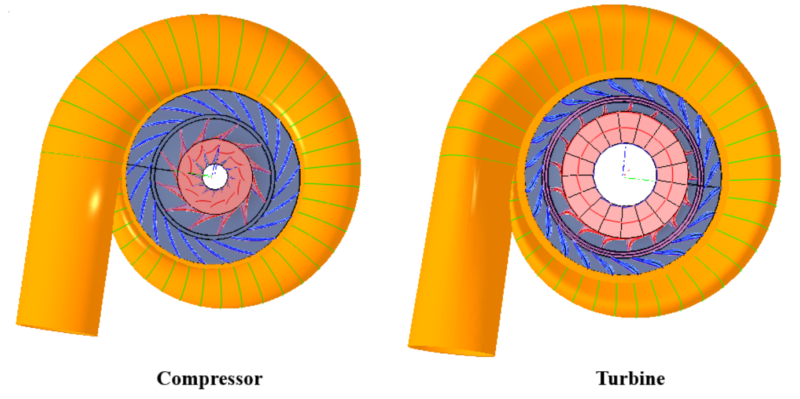
Figure 5. Turbocharger Centrifugal Compressor and Radial Turbine Designed in AxSTREAM
Where does Turbocharging Deliver the Most Value?
Mild hybrids:
The engine still supplies most of the sustained power, so conventional turbocharging supports downsizing. A 48 V electric booster can add low-speed response and support demanding combustion strategies, especially when the electrical infrastructure already exists. [8, 10]
Full hybrids and plug-in hybrids:
Electric drive covers much low-load operation and masks some boost delay. But turbocharging remains useful when a compact engine must sustain highway speed, towing, or performance after battery assistance is limited. In a battery-dominant PHEV, though, a complex booster may deliver too little lifetime benefit.
Performance hybrids:
Electric torque supplies the first response; the turbocharged engine sustains repeated or extended high load. Since high exhaust flow occurs more often, an e-turbo can meaningfully reduce airflow delay and recover more energy. [7, 9]
Commercial, heavy-duty, and off-highway hybrids:
Long grades, payload, high utilization, and limited charging access all strengthen the case for turbocharging. A turbocharged engine can handle sustained events without making the battery, cooling system, and vehicle unnecessarily heavy or expensive. [2, 3]
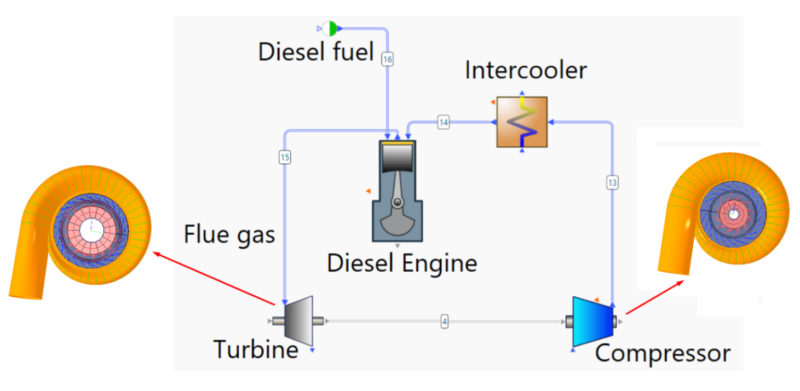
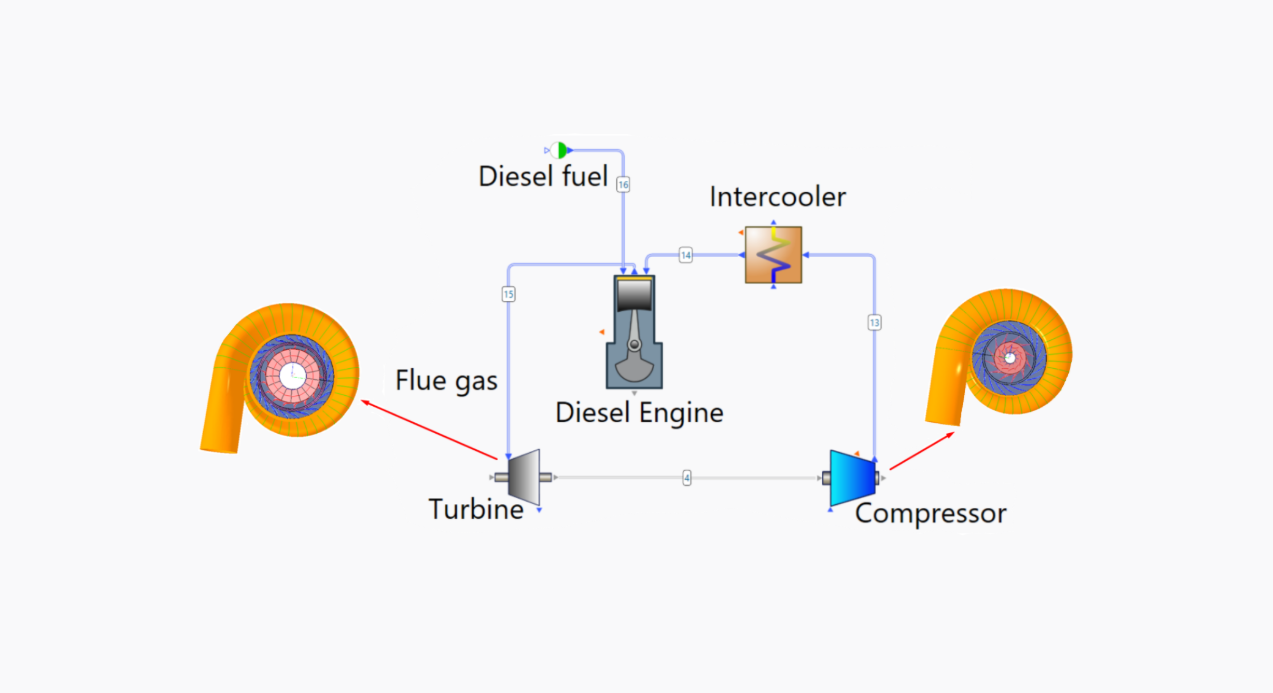
Figure 6. Turbocharged Diesel Engine within a Holistic AxSTREAM System Model
Series hybrids and range extenders:
A series-hybrid engine can run near selected speed-load points, so a simple fixed-geometry turbo may be enough, while a highly transient boosting system may add little. Startup behavior, thermal inertia, emissions, and the number of operating points remain decisive. [2, 13]
Where Does Turbocharging Add Too Little Value?
Turbocharging is less attractive when the engine runs rarely, stays near one moderate generator point, or doesn’t contribute much to lifetime energy use. In those cases, a naturally aspirated engine, a fixed-geometry turbo, or another range-extender architecture may deliver better lifecycle value instead.
E-boosting also comes with trade-offs, such as a high-speed rotor, inverter, cooling, lubrication, controls, packaging, and new failure modes. Bearings, rotor dynamics, structures, and thermal management must tolerate steep temperature gradients and rapid changes between motoring and generating. So the added complexity is only justified by measurable vehicle-level gains.
How to Design a Turbocharger System with AxSTREAM?
A hybrid turbocharger must remain efficient and stable from surge to choke, all while respecting turbine flow capacity, shaft speed, rapid starts, motoring and generating modes, thermal limits, and aftertreatment needs. That’s why broad map efficiency, surge margin, compressor outlet temperature, backpressure, response, and reliability matter more than any one peak-efficiency number.
AxSTREAM supports preliminary compressor and turbine sizing, 1D meanline and 2D streamline analysis, map generation, 3D blade development, CFD, structural assessment, and optimization. Design-of-experiments methods help balance competing objectives instead of optimizing one operating point.
AxSTREAM RotorDynamics evaluates natural frequencies, mode shapes, stability, unbalance response, bearings, and sensitivity. The resulting component maps can be linked to 0D and 1D engine and powertrain models to assess fuel use, emissions, response, thermal behavior, and hybrid energy management over the target cycle.
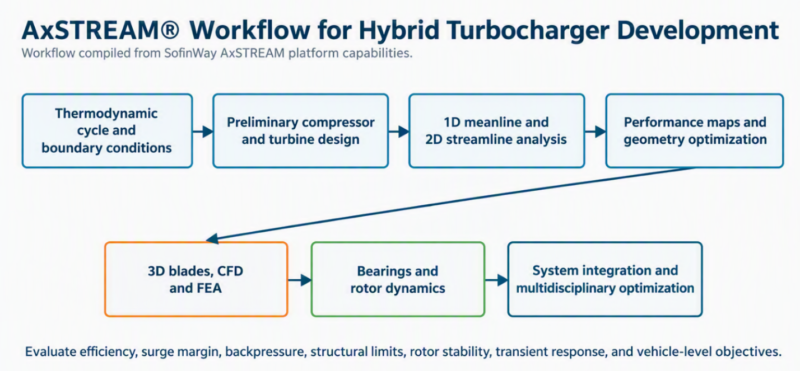
Figure 7. Integrated AxSTREAM Workflow from Preliminary Sizing and Mapping to 3D Design, CFD/FEA, and Rotor-Dynamic Assessment
Turbocharging is Still Relevant, Just More Selective and More Integrated
Hybridization does not eliminate the need for compact, efficient, sustained power. Conventional turbochargers still suit applications where simplicity and power density dominate. E-turbos make sense when rapid airflow control or exhaust-energy recovery occurs often enough to offset extra cost and complexity.
The strongest candidates are mild hybrids, performance hybrids, and commercial or off-highway vehicles with substantial engine use and prolonged load. The weakest are battery-dominant vehicles and lightly used range extenders. The final choice ultimately comes from cycle simulation that connects aerodynamics, electrics, controls, emissions, thermal management, bearings, and rotor dynamics. To make that decision easier, teams can leverage a multidisciplinary workflows and tools, like AxSTREAM, that links compressor and turbine aerodynamics with engine operation, electrical energy management, structural limits, bearings, and rotor dynamics.
Turbocharging was once a near-default choice for combustion engines. In hybrid vehicles, the question is no longer whether turbochargers are still relevant, but where they create enough system-level value to justify their inclusion. That decision must be made system by system and operating cycle by operating cycle, considering not only aerodynamic efficiency, but also electrical energy use, transient response, emissions, thermal management, packaging, reliability, and cost.
AxSTREAM supports this multidisciplinary evaluation from preliminary sizing and performance mapping to 3D aerodynamic design, CFD, structural assessment, and rotor-dynamic analysis. Whether the application calls for a conventional turbocharger, electrically assisted boosting, or exhaust-energy recovery, the right solution is the one that delivers measurable benefits across the vehicle’s actual operating cycle.
To evaluate or optimize a turbocharger for a specific hybrid architecture, contact SoftInWay with your operating cycle, boundary conditions, packaging constraints, and performance objectives.
References
1. Suciu, C. C., Igret, S. V., Vetres, I., and Ionel, I. “Review of the Integration of Hybrid Electric Turbochargers for Mass-Produced Road Vehicles.” Energies 17(6), 1484, 2024.
2. de Salis, R. T. “Rapid Physics-Based Synthesis of Diesel Engine Models for Hybrid Powertrain Optimization.” Vehicles 8(5), 110, 2026.
3. SAE International. “Using Turbogenerators for Energy Recovery in Turbocharged Hybrid Powertrains.” Technical Paper 2025-24-0100, 2025.
4. Chakrapani, V., O’Donnell, R., Fatouraie, M., and Wooldridge, M. “Characterization of High-Power Cold-Start Emissions Part 1.” SAE International Journal of Engines 18(6), 2025.
5. Chakrapani, V. et al. “Characterization of High-Power Cold-Start Emissions Part 2.” SAE International Journal of Engines, 2025.
6. Thornton, M., Burton, J., Miller, E., and Ragatz, A. “Investigation of Emissions Impacts from Hybrid Powertrains.” NREL/TP-5400-75782, 2020.
7. Garrett Motion Inc. “Electric Turbocharger Technology” 2026.
8. Garrett Motion Inc. “48V Electric Air Compressor for Mild Hybrid Vehicles” 2026.
9. Garrett Motion Inc. “What Is an Electric Turbocharger?” 2026.
10. BorgWarner Inc. “Electric Boosting Technologies” 2026.
11. BorgWarner Inc. “First Global eTurbo Business for High-Voltage Hybrid Vehicle Application.” May 18, 2021.
12. Teodosio, L., De Bellis, V., and Bozza, F. “Fuel Economy Improvement and Knock Tendency Reduction of a Downsized Turbocharged Engine.” SAE technical paper.
13. Al Khoury, J., and Bou-Nader, W. “Design and Simulation of Turbogenerators for Series Hybrid Electric Vehicles.” Energy Conversion and Management 236, 114078, 2021.
"*" indicates required fields