Jun 10, 2026
The Key Advantages of Foil Bearings in Turbomachinery: When to Choose Oil-Free Technology
In high-speed turbomachinery, conventional oil-lubricated bearings often become a system-level bottleneck due to lubrication complexity, contamination risk, and thermal limitations. Bump foil bearings (BFBs) address these challenges by enabling oil-free operation using only a thin gas film for lubrication. Unlike traditional oil-lubricated sliding or rolling-element bearings, foil bearings eliminate the need for complex oil systems, making them ideal for many modern high-speed turbomachinery applications.
In this article, we explore the unique architecture of bump foil bearings, why they matter, their key advantages, limitations, ideal applications, and how tools like AxSTREAM RotorDynamics and Bearing help engineers implement them effectively.
Understanding the Bump Foil Bearing Architecture
A BFB consists of two primary foil layers housed within a sleeve: a smooth top foil that forms the bearing surface and a corrugated bump foil underneath that acts as a resilient spring.
As the shaft rotates at high speeds, it pumps process gas or air into the converging gap, generating a pressurized lubricating film that lifts the shaft off the top foil. This compliant structure provides inherent damping and the ability to accommodate thermal expansion, misalignment, and shock loads–characteristics that set foil bearings apart from other bearing technologies.
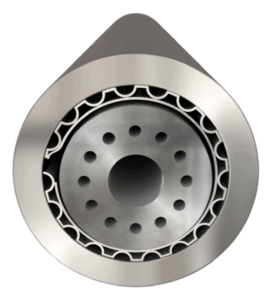
Figure 1. Foil bearing for oil-free technology
Why Bump Foil Bearings Matter and When Traditional Bearings Fall Short
When it comes to turbomachinery like microturbines, turbochargers, compressors, expanders, and air cycle machines, they often operate under demanding conditions including high rotational speeds, extreme temperatures, or environments where oil contamination is unacceptable. Therefore, engineers need to carefully evaluate different types of bearings to determine which solution best fits their specific application and operating conditions.
Engineers could evaluate traditional oil-lubricated bearings which require auxiliary systems, like pumps, coolers, filters, seals, but they add weight, complexity, cost, maintenance, and potential failure points.
Engineers may also evaluate rolling-element bearings which come with speed limits, lubrication, and heat dissipation challenges at very high speeds or temperatures.
Foil bearings address many of these challenges through self-generated lubrication and a compliant design, resulting in simpler, lighter, cleaner, and more reliable systems.
However, they are not a universal solution. Ultimately, selecting the right bearing technology comes down to a clear understanding of the specific operating conditions of the application.
Key Advantages
Foil bearings excel through oil-free operation, which eliminates lubrication systems, reduces weight and emissions, and prevents contamination. They are suitable for extremely high-speed applications, capable of reaching rotational speeds of hundreds of thousands of rpm. This far exceeds the practical limits of traditional rolling-element bearings.
Furthermore, BFBs maintain performance across an extensive temperature range, functioning reliably in environments from cryogenic temperatures to several hundred degrees Celsius, especially when advanced wear-resistant coatings are applied to them. Because they require no oil changes or scheduled lubrication, they offer a maintenance-free solution with high reliability and a simplified system design.
Finally, foil bearings’ unique compliant structure further enhances rotordynamic stability and tolerance to misalignment and thermal growth.
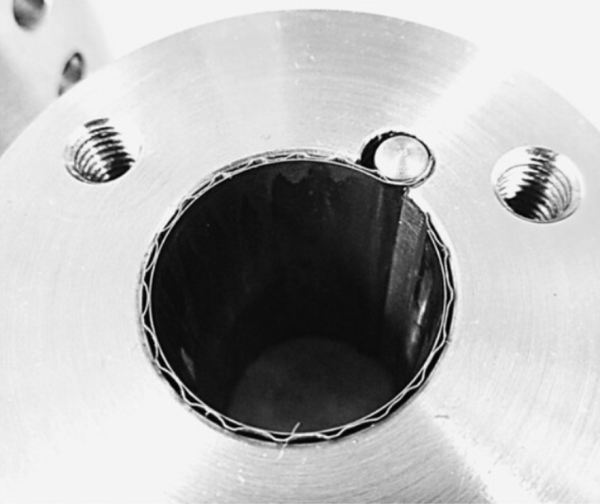
Figure 2. Example of a foil bearing in a high-speed turbomachine
When to Use Bump Foil Bearings: Ideal Applications and Conditions
BFBs are suitable for the following scenarios:
- High Rotational Speeds with Moderate Loads: Best suited for lightly to moderately loaded rotors. The “sweet spot” is often small-to-medium shaft diameters running at tens or hundreds of thousands of rpm.
- Oil-Free or Contamination-Sensitive Environments: Used in oil-free or extreme environments such as aircraft air systems, cryogenic turbomachinery, microturbines, and vacuum pumps, where conventional lubricating oils would contaminate, freeze, or degrade.
- Extreme Temperatures: Hot sections of gas turbines, turbochargers, waste heat recovery systems, or high-temperature expanders where oil would degrade or coke.
- High Reliability and Long Continuous Operation: Remote or hard-to-maintain installations benefit from the maintenance-free nature of the bump foil bearings.
Key Limitations
However, BFBs come with several important limitations that engineers must carefully consider. Compared to traditional oil-lubricated or rolling-element bearings, they generally offer lower load-carrying capacity, making them best suited for lightly to moderately loaded rotors.
At low speeds or during frequent start-stop cycles, the shaft and foil surfaces experience direct contact, leading to wear that can limit operating life, so advanced wear-resistant coatings must be applied to them to function reliably.
Foil bearings can also be more sensitive to manufacturing tolerances, thermal distortions, and rotor misalignment, requiring precise design and assembly. Additionally, while they provide good damping, their dynamic characteristics can introduce certain rotordynamic challenges at specific operating conditions, and parasitic power losses tend to be higher than rolling-element bearings at moderate speeds. These factors make foil bearings less ideal for heavy-duty, low-speed, or highly loaded applications where conventional bearing technologies may still be more appropriate.
Evaluate with AxSTREAM RotorDynamics and Bearing
Modern software tools, such as AxSTREAM RotorDynamics and AxSTREAM Bearing, enable engineers to evaluate foil bearings early in the design process.
Key capabilities include:
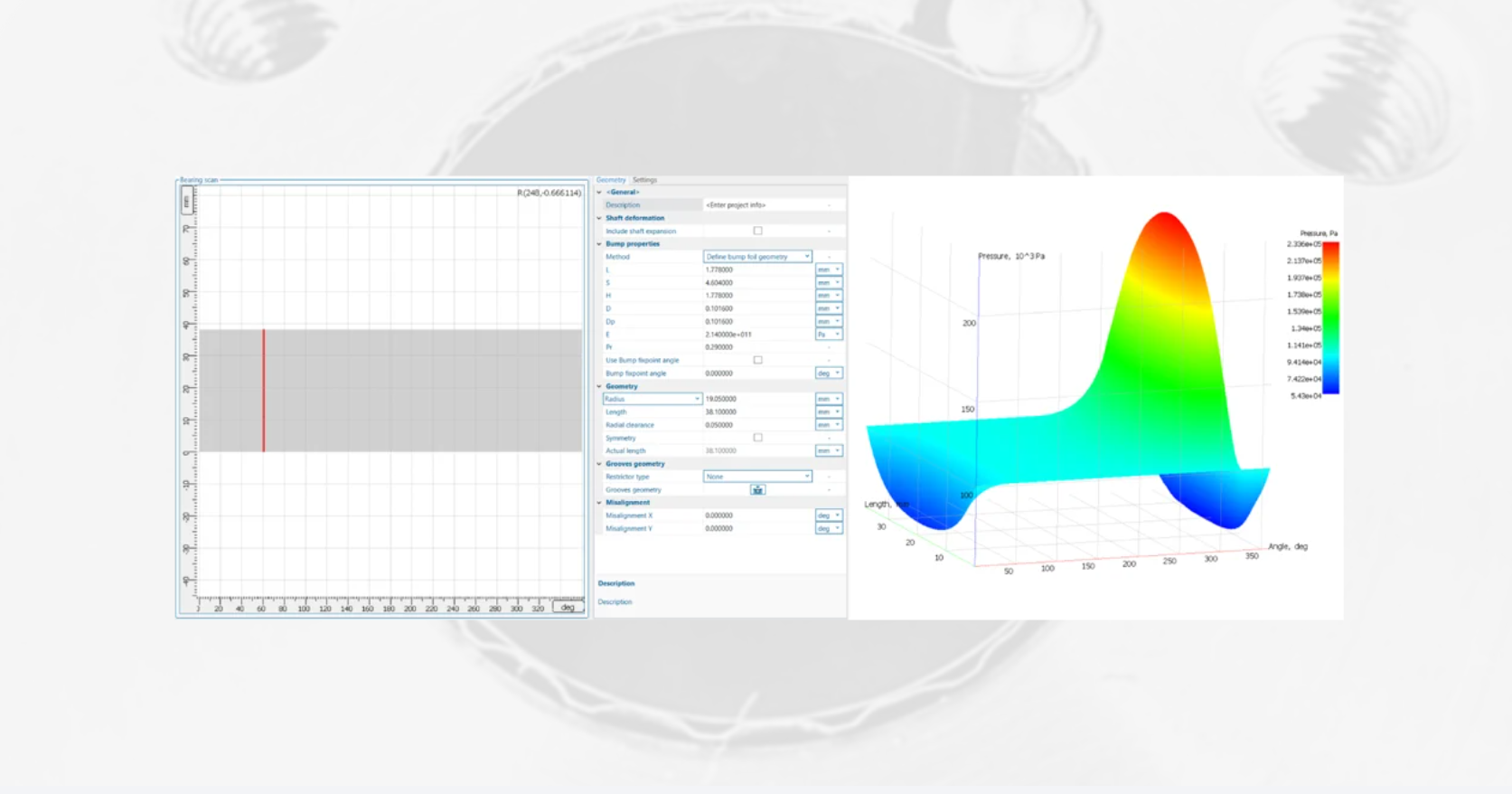
- Modelling gas foil bearings using geometrical bump properties or stiffness characteristics.
- Prediction of clearance and pressure distribution, relative eccentricity, and power loss.
- Calculation of dynamic coefficients across the speed range.
- Integration with full rotor-bearing system analysis for transient simulations.
By incorporating foil bearing characteristics directly into static and dynamic analyses, engineers can confidently determine the best bearing solution, optimize rotor designs, and reduce development time and design risk.
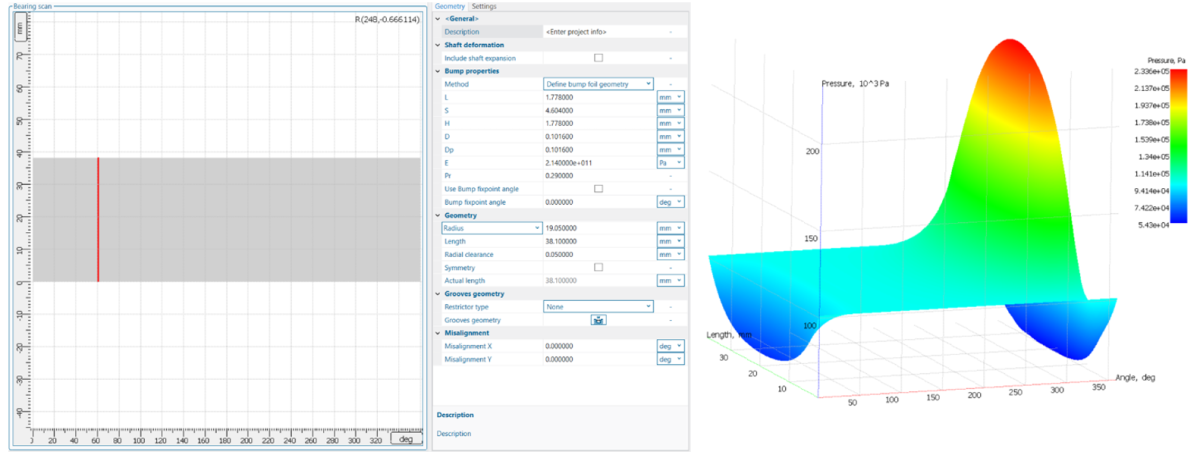
Figure 3. Bump foil bearing modeling and pressure distribution in AxSTREAM Bearing
A Modern Solution for Evolving Demands
Foil bearings represent a transformative technology for high-speed, oil-free turbomachinery. They have many advantages when used in applications that require high rotational speeds, wide temperature ranges, compactness, and minimal maintenance. When loads are moderate and speeds are high, they deliver superior reliability, efficiency, and simplicity compared to traditional bearings.
However, successful implementation demands thorough analysis of operating conditions, transients, and rotordynamics. With advanced modeling tools like AxSTREAM RotorDynamics and Bearing, engineers can accurately assess when foil bearings are the right solution and bring reliable oil-free designs to market faster.
References
- [1] Agrawal, G. L. “Foil Air/Gas Bearing Technology — An Overview.” ASME Paper 97-GT-347.
- [2] Al-Bender, F. Air Bearings: Theory, Design and Applications. Wiley, 2021.
"*" indicates required fields