Nov 16, 2016
Can 1D Tools be Used to Design an HVAC System?
Update – March 1, 2023: AxCYCLE and AxSTREAM NET are our legacy software packages, deprecated by AxSTREAM System Simulation. System Simulation was born out of the union of the legacy AxCYCLE and AxSTREAM NET software packages.
The heating, ventilation, and air-conditioning (HVAC) system is arguably the most complex system that is installed in a house and it is responsible for a substantial amount of the total house energy used. A right-sized HVAC system will provide the desired comfort and will run efficiently. Right-sizing of a HVAC system is the selection of equipment and the designing of the air distribution system to meet the accurate predicted heating and cooling loads of the house. Rightsizing the HVAC system begins with an accurate understanding of the heating and cooling loads on a space, however, a full HVAC design involves more than just the load estimate calculation as this is only the first step of the iterative HVAC design procedure. Heating and cooling loads are dependent on the building location, sighting, and the construction of the house, whereas the equipment selection and the air distribution design are dependent upon the loads and each other.
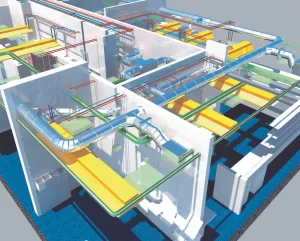
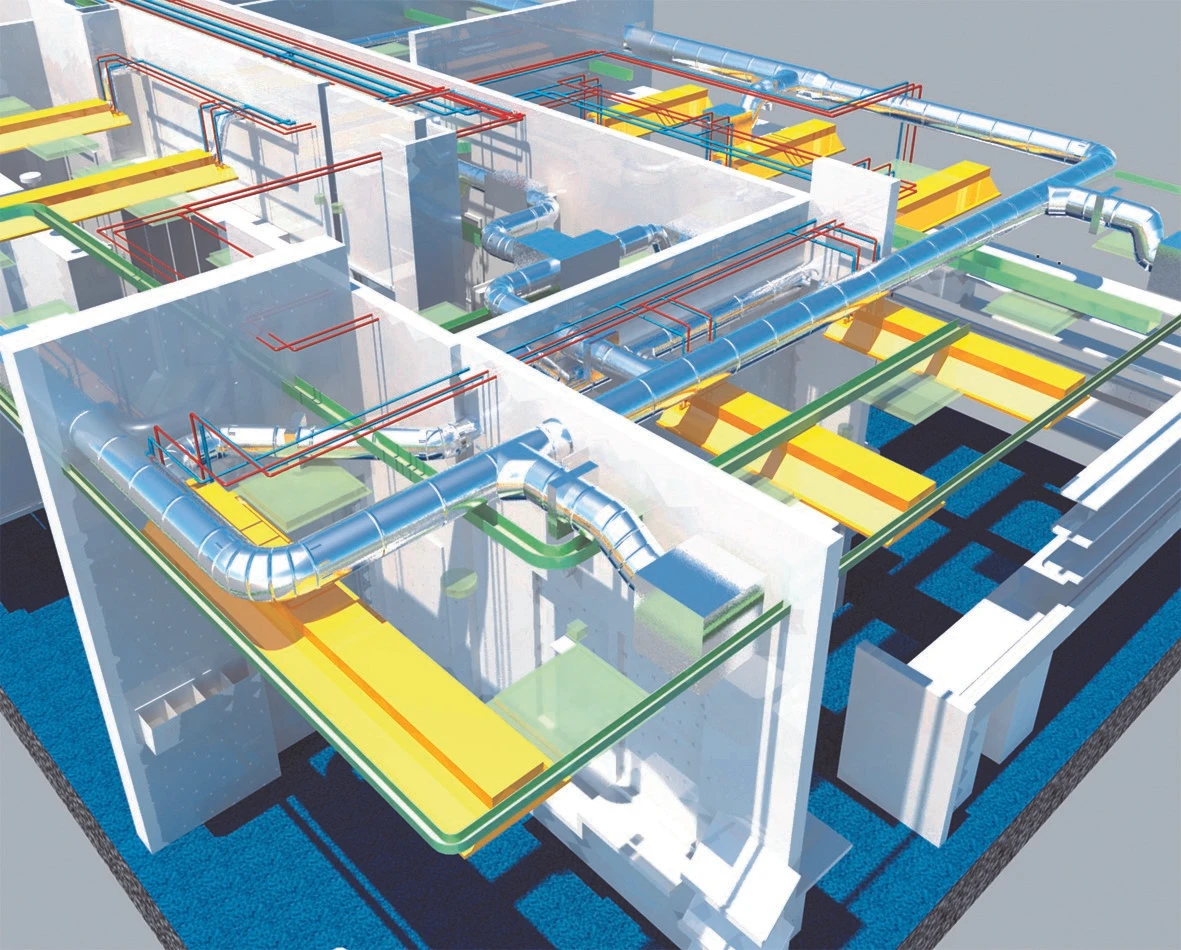
Figure 1: A 3D model representing the HVAC ducting in a building.
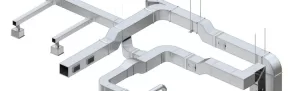
Figure 2: Ducts layout for HVAC
The initial design iteration starts with tools such as AxCYCLE™, the thermodynamic design, analysis and optimization tool offered by SoftInWay Inc., based on which the initial specification for the equipment selection is obtained. Furthermore, it is more important to study the distribution of the air into the building to further refine the design iterations. Figure 1 shows the ducting layout in a typical building. The ducting design is a major activity not only from the point of pressure loss but also to ensure the air flows into the room effectively.
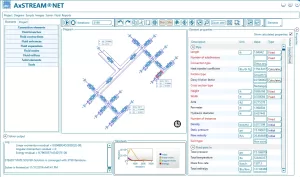
Figure 3: Design and Analysis of the HVAC ducts in AxSTREAM® NET.
Figure 2 shows the ducting layout with the air discharge ports. The branching of the duct and the location of the discharge ports affect the cooling in the room which needs to be analyzed in detail. However, to begin the initial design process, it is more appropriate to use a 1D tool such as AxSTREAM® NET which can be used to model the flow through the duct and estimate the pressure loss and cooling effectiveness based on whether the thermodynamic cycle can be further fine-tuned iteratively before any detailed 2D/3D analysis is performed.
To learn more about how AxSTREAM® NET can be used for HVAC design and analysis, please write to info@softinway.com.
"*" indicates required fields