Mar 9, 2022
Rotor Dynamics Study of 4-Stage Compressor – from Theory to Application

Rotor dynamics analysis plays a critical role in ensuring the safety, reliability, and efficiency of rotating machinery. From steam turbines in power plants to the compressors in aircraft engines, understanding how rotors behave under various operating conditions is essential. In this case study, we explore the rotor dynamics study of a 4-stage compressor, focusing on lateral vibrations, bearing modeling, and critical speed analysis. These insights help engineers predict and prevent excessive vibration, extend equipment lifespan, and ensure compliance with industry standards such as API and ISO.
Why Rotor Dynamics Matters in Turbomachinery
Although these rotating machines are different, the approaches to modelling their rotor dynamics are pretty much the same, since similar processes occur in rotating parts which differ in their vibrations from the non-rotating machines.
Do you remember the example of rotating washing machine? Have you ever seen it jumping on the floor trying to squeeze out your closet? We bet you have. This is the simplest example of the increased unbalance affecting the amplitudes of machine vibrations. Washing machines are designed to experience these noticeable vibrations during their operation without breaking. But the steam turbine or compressor rotors which have the tight clearances between the impellers and the casing can not boast of that leeway. In addition to that, the excessive vibrations significantly influence the machine’s useful life due to the increased fatigue.
This is why the rotor dynamics predictions are one of the most important parts of rotating machine analyses. And although they may seem easier than comprehensive stress-strain investigations of machine components, in some cases the rotor dynamics analysis can be trickiest part.
Usually, the rotor dynamics analyses are divided into lateral and torsional stages depending on the nature of rotor response to be used. They are discussed in different types of standards (API [1], ISO [2], etc.). Let’s consider the example of the lateral vibrations of a 4-stage compressor rotor with an operational speed of 8856 rpm.
Lateral Vibrations in a 4-Stage Compressor Rotor
Fig. 1 – 4 Stage Compressor Rotor
This rotor rotates in the 4 pad tilting, pad oil film journal bearings. The characteristics of these bearings should be determined carefully to ensure that there will not be an excessive wear, heat generation or friction in them.
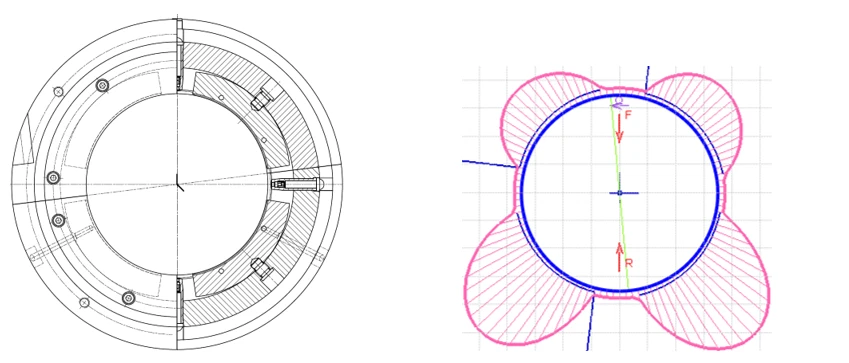
Fig. 2 – Oil Film Journal Bearing with Four Tilting Pads: Drawing and Oil Pressure Distribution in the Middle Section
On top of that, the bearings provide the rotor with additional stiffness and damping characteristics which require calculation and appropriate consideration in the rotor model.
The rotor design includes four impellers connected by the shaft. The impeller length is significantly less than their diameters which allows them to be considered as point masses – namely the objects with zero length but carrying all inertia properties.
The shaft is modeled by the beam elements based on the finite element method – an engineer’s best friend in our modern world.
After all, the simplified rotor dynamics model includes the shaft; the impellers, represented by the points masses connected to it; and the bearings modeled by springs and dampers with previously determined properties; and attached to the shaft in the locations of the bearing seats.
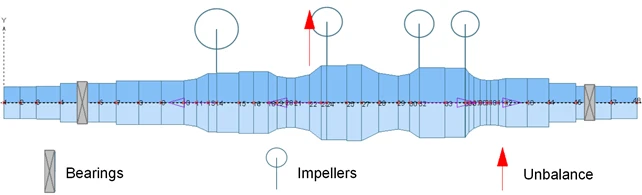
Fig. 3 – Rotor Dynamics Model of the 4 Stage Compressor
The further scope of rotor dynamics analyses is the prediction of rotor vibration properties under different conditions. The lateral analyses include critical speed determination for actual bearing properties: critical speed map plot for changing bearing properties; unbalance response modelling for maximal allowable residual unbalances, placed in the locations of maximal vibration deflections; stability estimations; and harmonic and transient response predictions, under the action of the corresponding excitation sources, etc.
The unbalance response predictions indicate where the maximal amplitude of rotor vibrations occur, therefore comparing them with the clearances tells engineers whether this response is safe or not.
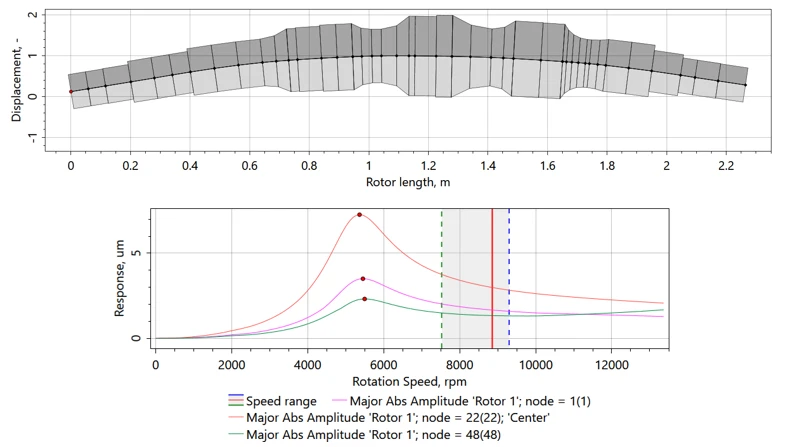
Fig. 4 – First Mode of Rotor Vibrations and the Corresponding Response in the Form of Peak Vibration Amplitudes Due to the Action of Maximal Residual Unbalance Placed in Maximal Deflection Location of the First Mode
In addition to the types of rotor dynamics analyses, there is a huge amount of different conditions and excitation sources which should be considered during the analyses. These are cross-coupling forces, seals, motors, gears, and couplings, etc. The correct representation of them in simplified models is the duty of an engineer whose expertise bridges connecting the best practices of ages and the latest research with a certain machine here and now. Experienced engineers using the most powerful rotor dynamics software make our world a better, safer place for everyone.
Rotor Dynamics Software for Accurate Simulation
Rotor dynamics simulations are an important part of the design process of any turbomachine. These simulations involve various analyses of bearing parameters and rotor vibration response which can usually be both lateral and torsional under different excitation sources. AxSTREAM Bearing™ and AxSTREAM RotorDynamics™ provide their users with comprehensive modeling of bearing and rotor operation on the basis of recognized approaches and API standards. To learn more about AxSTREAM Bearing™ and AxSTREAM RotorDynamics™, schedule a meeting with our team at Info@SoftInWay.com or request a trial here
References
"*" indicates required fields