Mar 13, 2018
Different Criteria Options in Turbomachinery Design Software
When people design turbomachines, whether it be a turbine, compressor, blower, or fan, they need to find the optimal design based on their criteria under certain constraints.
With AxSTREAM®, people are given several options for their design criteria, which provides flexibility. With that being said, we often get asked what the differences are, and here is a brief explanation addressing just that.
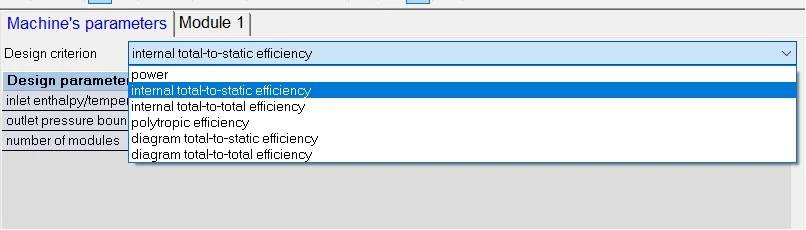
The design criteria menu includes power, internal total-to-static efficiency, internal total-to-total efficiency, polytropic efficiency, diagram total-to-static efficiency, and diagram total-to-total efficiency, as shown in Figure 1
Figure 1 – Design Criteria Options in AxSTREAM® Preliminary Design
Power and efficiency are related, but not always the same thing, especially when the boundary conditions are not fixed as design parameters. In AxSTREAM’s Preliminary Design Module, the user can set boundary conditions such as pressure at the inlet and outlet, inlet total temperature, etc., as a range instead of a specific value. Along with other parameters, the solver generates hundreds or even thousands of solutions within the range.
After this step is completed, the user can look at all the detailed parameters with Design Space Explorer, further filtering them, which enables the user to choose the best solution for their design by changing the value of the range as in Figure 2.
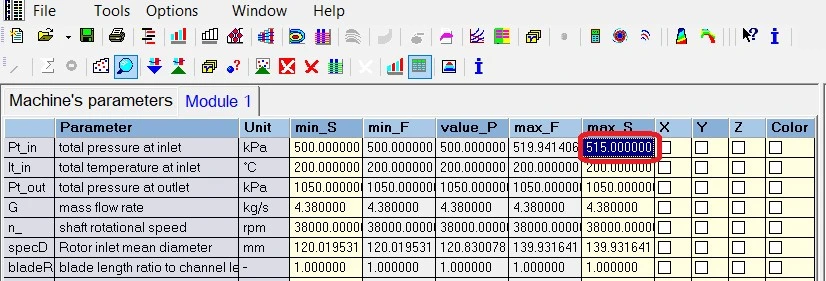
Figure 2 – Design Space Explorer
The total-to-static efficiency shows the efficiency value taking total quantities at the inlet and static quantities at the outlet, i.e., considering exit energy as loss, while the latter takes total energy at both the inlet and outlet into account during the calculation.
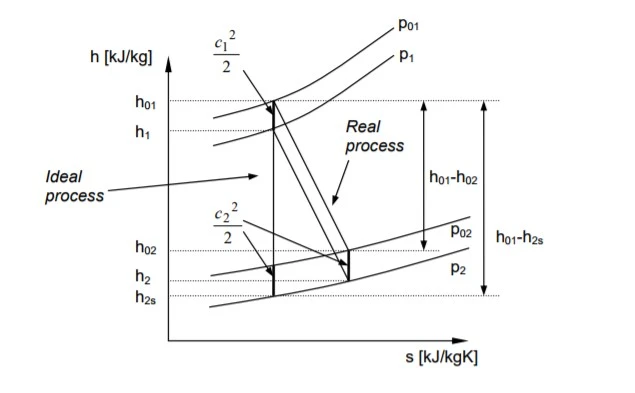
Figure 3 – H-S diagram of expansion process
So with all this being said, what is the difference between internal and diagram efficiency? The simple answer is that internal efficiency is convenient when the flow path has no extraction/reinjection, while diagram efficiency is used for flow paths with extraction/reinjection. Figure 3 shows only a single-stage expansion, but for multi-module machines, diagram efficiency is the number to look at.
The polytropic efficiency removes the penalty for higher pressure ratios so that compressors of equal aerodynamic quality but significantly different pressure ratios would have the same polytropic efficiency, though a different isentropic efficiency, so it is a good indicator to compare designs with a different pressure ratio/head.
There are more details in our AxSTREAM® help files on this topic. If you are interested in learning about how AxSTREAM® works for your turbomachinery design/analysis as a complete platform, please contact us at Info@Softinway.com for a free demo.
Reference:
- https://ocw.mit.edu/courses/16-050-thermal-energy-fall-2002/
- AxSTREAM® Help file.
"*" indicates required fields