Jun 9, 2017
History of Refrigeration
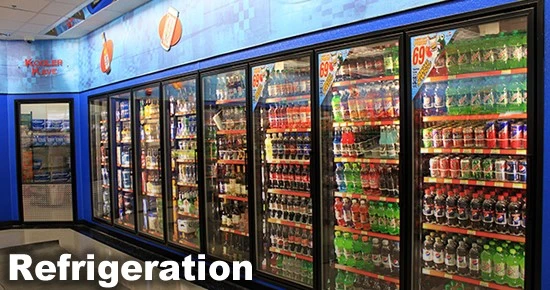
 In its natural state, heat flows from higher to lower temperature regions. Refrigeration cycles are utilized to modify or reverse this cycle, using work to obligate heat to flow in the direction that is desired and align with increasing temperature from a low-temperature region to a higher.
During the earliest records of the “cooling” process being invented, people harvested ice to refrigerate, cool, and conserve food. As time progressed, humanity’s basic needs changed, and new ways to manipulate temperature started being explored. Major research into refrigeration began with the creation of a pump to create a partial vacuum container, which absorbs heat from the air. That being said, while the experiment was successful, it did not have any practical applications.
In the early 1800’s, people preserved their food by storing food and ice in iceboxes. General Electric decided to design a refrigeration unit that was powered by gas, which eliminated the use of motors, decreasing the size, and soon moved to a refrigeration system that was powered by electricity. The first commercial use of refrigeration was to produce ice in regions with hotter climates. Refrigeration systems became the solution to ice shortages by enabling areas with environmental limitations to produce their own ice, thus reducing the product’s scarcity.
With the invention of chlorofluorocarbons, Frigidaire was able to make home and consumer refrigeration systems better, cheaper, lighter, and smaller. Of course, this was back in the time when CFC and Freon were still considered safe choices. Since then, many other refrigerants have been chosen to replace R22.
The thermodynamic cycle that is associated with the refrigeration process is known to be the Carnot cycle -a reversible isothermal cycle, where heat is transferred at a constant temperature. To learn more regarding the thermodynamic cycle of refrigeration, please refer to one of our older posts or contact our engineering team for our heat balance course and tool!
"*" indicates required fields