Nov 16, 2016
Enhanced Design Capabilities Using CFD
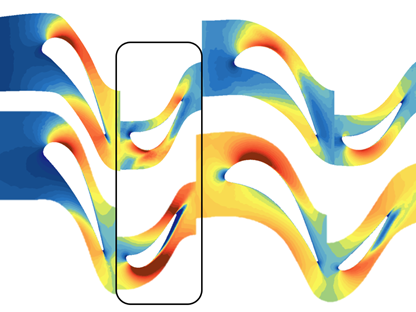
The use of computational fluid dynamics (CFD) in turbomachinery design is getting more and more popular given the increased computational resources. For the design process, however, there is no need for extensive CFD capabilities, as the effort is put on minimizing engineering time while obtaining a design that is about 90% optimized. Here we are presenting two cases where CFD is used to derive significant information for pump design.
First, the influence of the blade shape on the parameters of the single-blade hydrodynamic pump was studied by Knížat et al [1]. The investigation of the pump properties was carried out experimentally with the support of CFD methods. The accuracy of the applied steady-state calculations was satisfactory for the design process of a single-blade pump, because of the good agreement between measured and calculated power curves.
For the CFD, the Menter SST (shear stress transport) model of turbulence was chosen. This model effectively combines the robustness and accuracy of the k-ω model in regions close to the wall with the model k-ε working better in the free stream away from the wall. These improvements make the SST model more accurate and reliable compared with the standard k-ω model. The CFD calculations were used for the estimation of pump power curves. The specific energy, torque, and hydraulic efficiency were evaluated for each flow rate.
This study showed that the position of the best efficiency point is sensitive to the blade shape. Thus, it is necessary to form the blade more carefully than in the case of a classical multi-blade pump. It also follows from the calculations that the pump flow is non-symmetrical, and it may cause increased dynamic load on the shaft.
In a second study conducted by Yang et al, a double volute centrifugal pump with relatively low efficiency and high vibration was redesigned to improve the efficiency and reduce the unsteady radial forces with the aid of unsteady CFD analysis. The concept of entropy generation rate was proposed to evaluate the magnitude and distribution of the loss generation inside the pump. It was found that the wall friction, wakes downstream of the blade TE, flow separation near the hub on the pressure surface side, and mixing loss in the volute are the four main sources leading to significant entropy generation in the baseline pump. In the redesigned model, the entropy generation near the hub on the pressure surface side was diminished, and the loss in the volute was also reduced, while the loss generated by wall friction was increased with the blade number. In general, the entropy generation rate was a useful technique to identify the loss sources, and it is really helpful for the redesign and optimization of pumps. The local Euler head distribution (LEHD) obtained in viscous flow was proposed to evaluate the flow on constant span stream surfaces from the hub to shroud. It was found that the Kutta condition was not necessarily satisfied at the blade leading edge in viscous flow. A two-step-form LEHD was recommended to suppress flow separation and secondary flow near the hub on the pressure side of the blade in a centrifugal impeller. The impeller was redesigned with two-step-form LEHD, and the splitter blades were added to improve hydraulic performance and to reduce unsteady radial forces.
The use of CFD integrated into a streamline engineering platform like AxSTREAM would be a valuable tool for every engineer. Try AxSTREAM and AxCFD to conduct your own research and lead to significant outcomes related to turbomachinery design, analysis, and optimization!
[2] Computational fluid dynamics- based pump redesign to improve efficiency and decrease unsteady radial forces. Yan, P., Chu, N., Wu, D., Cao, L., Yang, S., & Wu, P. (2017). Journal of Fluids Engineering, Transactions of the ASME, 139(1)
"*" indicates required fields